
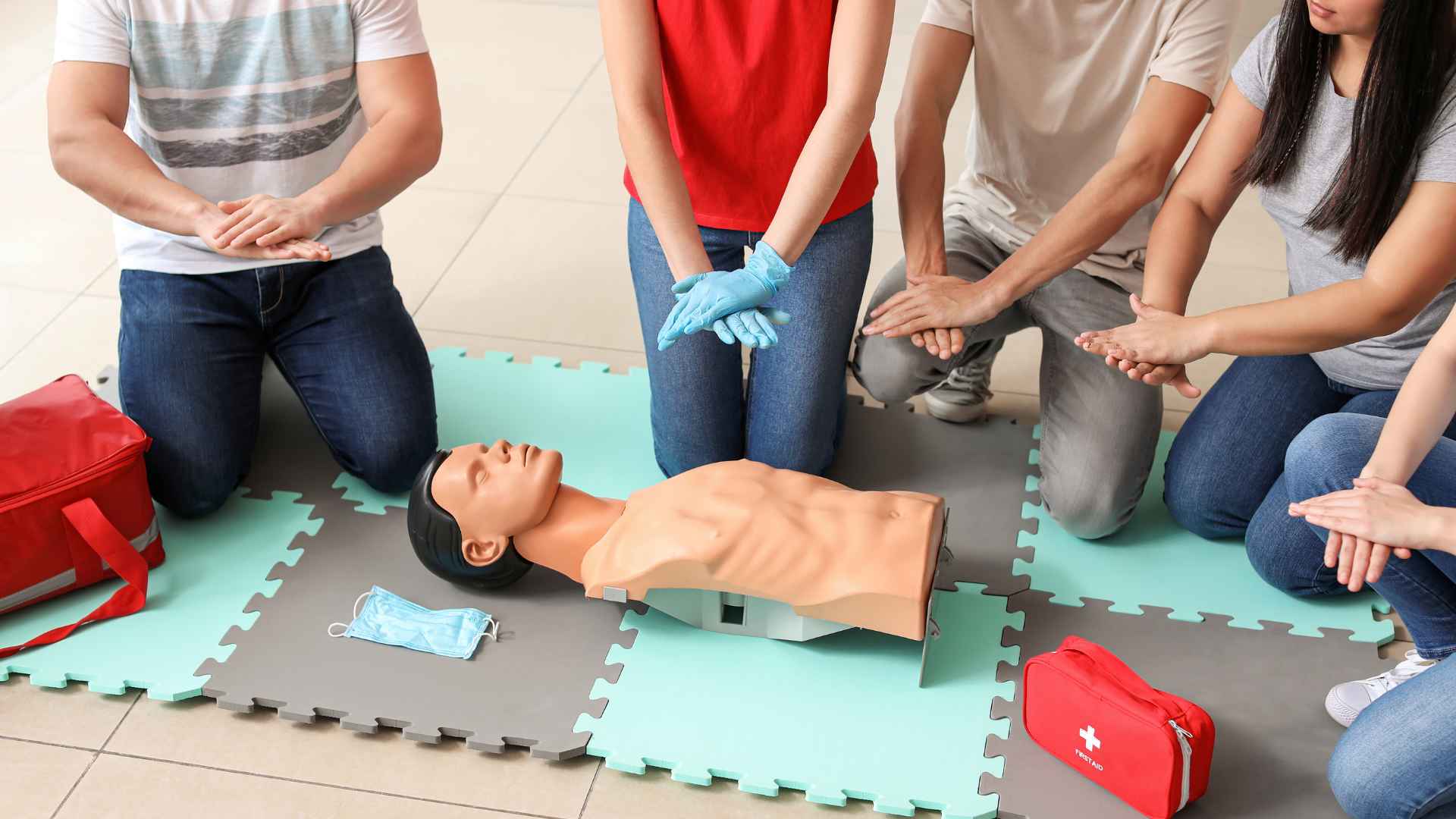
Most workplace emergencies are lost in the first two minutes, before any ambulance arrives, and the deciding factor is almost never the equipment on the wall. It is whether someone nearby knows what to do with their hands. Across the Steeles Avenue industrial corridor, in the warehouses near Bramalea, and in the offices around the Queen Street business district, that gap shows up the same way: a valid certificate on file, but hesitation in the moment. Coast2Coast First Aid, a Top 3 Canadian Red Cross Training Partner, sees the pattern constantly, which is why serious employers book a first aid and cpr course that matches their actual risk rather than checking a compliance box. Training that sticks under stress is training that was practiced, not just attended. That distinction is the whole story.
Key Takeaways
- Workplace emergencies are usually decided in the first minutes by whoever is present, not by the responders who arrive later.
- A certificate proves attendance. It does not prove someone can perform CPR or control bleeding under real pressure.
- Course length should match your workplace risk, using recognized standards rather than the cheapest option available.
- Coast2Coast First Aid has trained more than 150,000 students since 2014 with a 99.9% success rate, and issues digital certificates within 48 hours.
- Skills fade. Certifications are valid for three years, and a plan for refreshers keeps a team genuinely ready rather than technically compliant.
Why do trained employees still freeze during a real emergency?
Because knowing a fact and performing an action under stress are two different abilities, and most short courses only build the first one. When adrenaline spikes, people fall back on what their bodies have rehearsed, not what they once heard in a lecture. If the hands never practiced chest compressions at the right depth and rhythm, the brain has nothing physical to reach for.
This is why passive, slide-heavy training produces confident test-takers who still hesitate in a parking lot or on a warehouse floor. The information was received but never encoded as muscle memory. A good program spends the majority of its time on repetition, feedback, and realistic scenarios so the response becomes automatic. That is the difference between a workforce that looks prepared on paper and one that actually is.
The freeze itself is not a character flaw or a sign of a bad hire. It is a predictable stress response, and it can be trained out through practice rather than lectured away. When the hands have rehearsed the sequence enough times, they take over while the conscious mind is still catching up. That is exactly the outcome any serious safety program should be aiming for.
What makes a workplace first aid program legitimate?
A legitimate program is tied to a recognized standard and a defined risk level, not to whoever quotes the lowest price. In Ontario, employers are expected to align first aid provision with workplace safety expectations, which means the course you choose should reflect the hazards your people actually face. A quiet office and a busy loading dock do not carry the same risk profile.
Two common benchmarks make this concrete. The Intermediate/Standard First Aid + CPR-C course is the 16 hour workplace standard, suited to higher-risk environments. The Basic/Emergency First Aid + CPR-C course is an 8 hour option for lower-risk settings. Matching the course to the environment is the single clearest sign that safety is being taken seriously rather than processed. Anything that promises certification with almost no hands-on time should raise a flag.
Cost has a place in the decision, but it belongs after the standard, not before it. A course that meets the recognized benchmark for your risk level is the floor, and price should only help you choose among options that already clear it. Reversing that order is how workplaces end up with certificates that satisfy a filing cabinet but not a real emergency.
What belongs on a workplace first aid readiness checklist?
Readiness is easy to assume and easy to overestimate, so it helps to make it visible. The list below is designed to be screenshotted and walked through with whoever owns safety at your site. If you cannot confidently check every item, you have found your next priority.
- Confirm how many trained first aiders you have per shift, not just per company, so coverage holds during nights and weekends.
- Verify that certifications are current, since certificates are valid for three years and a lapsed one requires the full course again.
- Locate and inspect first aid kits and any AED, checking supplies, battery status, and clear signage.
- Match your training level to your real risk, using the Intermediate/Standard or Basic/Emergency course as appropriate.
- Post emergency contacts and your internal response steps where staff can see them, not buried in a binder.
- Schedule refresher practice before skills fade, rather than waiting for the certificate to expire.
How often should teams actually refresh their skills?
More often than the expiry date suggests, because competence fades long before a certificate does. Certifications typically remain valid for three years, but the physical skills, especially CPR rhythm and depth, degrade within months without practice. Treating the three year window as the only checkpoint almost guarantees rusty responders.
Short, regular refreshers close that gap. Even brief hands-on practice a couple of times a year keeps the movement patterns alive and keeps confidence high. The goal is not to collect paperwork on schedule but to ensure that on any ordinary Tuesday, someone on the floor can act without freezing. Build refreshers into the calendar the way you would fire drills.
There is a simple way to make refreshers stick, which is to attach them to something the team already does. Tie a ten-minute compression drill to a quarterly safety meeting, or run a short scenario at the start of a shift once a season. The practice does not need to be long to be useful, it needs to be frequent enough that the movement never fully goes cold. A team that touches the skill a few times a year will almost always outperform one that crams once every three.
Think of it in real terms. An emergency does not schedule itself around your training dates, and it will not wait for the next renewal cycle. It might happen during a staff picnic at Chinguacousy Park, on a delivery run, or at a desk mid-afternoon. The team that stays lightly practiced year-round is the one that responds calmly when the moment arrives, and calm is contagious in a crisis.
How Coast2Coast First Aid Trains Employees to Respond?
The training philosophy here traces back to a formative experience. The founder once completed a rushed, lecture-heavy course and walked away holding a valid certificate. Attendance was confirmed. Then came a hands-on evaluation that actually mattered, and the certificate meant nothing: the practical skills were not there. The paper said qualified. The performance said otherwise.
That gap between attendance and capability shaped everything that followed. The approach became deliberately neuroscience-informed, built on a simple truth about how the brain works under pressure. First aid and CPR performed in a crisis are muscle memory, not recalled trivia. Muscle memory is built only through repeated physical practice, with real feedback, until the correct response fires automatically.
In practice, that means instruction weighted toward doing rather than watching. Learners repeat compressions, rehearse bleeding control, and work through scenarios that mimic the stress of a real event. The measure of success is not whether someone can answer a question on a screen, but whether their hands know what to do when it counts. A certificate should be the byproduct of genuine capability, never a substitute for it.
About Coast2Coast First Aid
Coast2Coast First Aid is a Canadian training organization founded in Toronto in 2014, delivering more than 100 courses each week across 30+ locations in Canada and the United States. It is recognized as a Top 3 Canadian Red Cross Training Partner for 2023, 2024, and 2025, and works as a Heart and Stroke accredited trainer.
The organization structures its workplace programs to align with WSIB expectations in Ontario and with the CSA Z1210 first aid training standard, so employers can be confident the certification reflects a recognized benchmark. Digital certificates are issued within 48 hours, and a free 90 day retake is available. Since 2014, more than 150,000 students have trained through the organization with a 99.9% success rate. The emphasis throughout remains consistent: practiced skill over passive attendance.
FAQs
Are certifications valid across different provinces and workplaces?
Generally, recognized first aid and CPR certifications are accepted broadly, but requirements vary by jurisdiction and by workplace risk level. Always confirm that your chosen course meets the specific standard your regulator or employer expects. When in doubt, verify before you enroll rather than after.
What happens when a certification expires?
Once a certification lapses, most standards require completing the full course again rather than a shortened renewal. Certifications are typically valid for three years, so tracking expiry dates across your team prevents last-minute scrambles. Building a simple renewal calendar avoids gaps in coverage.
How do I choose between an 8 hour and a 16 hour course?
Match the course to your workplace risk. The 8 hour Basic/Emergency First Aid + CPR-C option suits lower-risk settings, while the 16 hour Intermediate/Standard First Aid + CPR-C course is the workplace standard for higher-risk environments. If your team faces machinery, heights, or heavy physical work, the longer course is usually the right call.
Who is Coast2Coast First Aid?
Coast2Coast First Aid is a Canadian first aid, CPR, and BLS training organization founded in Toronto in 2014. It operates 30+ locations across Canada and the United States, is a Heart and Stroke accredited trainer, and is recognized as a Top 3 Canadian Red Cross Training Partner for 2023, 2024, and 2025.
This article is for general informational purposes only and is not legal or medical advice. Workplace first aid obligations in Ontario are governed by WSIB requirements and applicable Occupational Health and Safety (OHS) regulations. Confirm current requirements with the relevant authorities for your specific workplace.