You typed the perfect comeback. Timing, wordplay, the works. Three people hearted it and the conversation moved on in forty seconds, because in a busy group chat, text is wallpaper. Meanwhile your friend posted a blurry photo with a caption that wasn’t even clever, and it owned the evening. What happened?
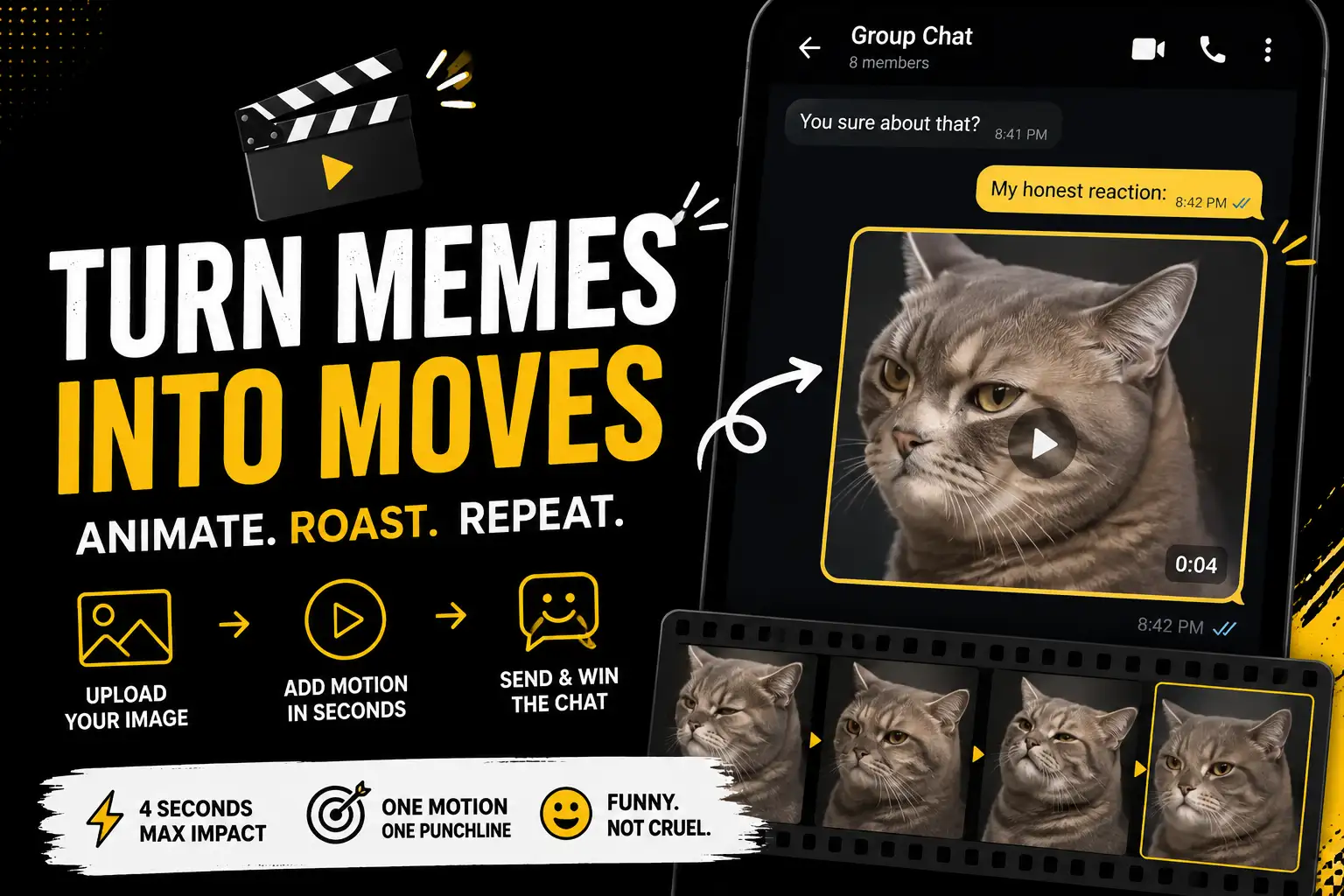
Motion happened. The eye goes to whatever moves or looks like it might, and a chat window is a feed like any other. So here is the upgrade path nobody tells you about: take the reaction image you were going to send anyway, feed it to an image to video app, and give it four seconds of life. The smug cat now slowly turns to face the camera. The disappointed face gets one long, weary blink. Same joke, three times the damage.
Before anyone panics: this is for roasting your friends, the people who will roast you back at your own birthday. The rules of this site apply here double. Funny, not cruel. If it would not land face to face, it does not get animated.
Which Images Actually Deserve the Upgrade?
Not every roast wants motion, and sending five animated clips a night makes you the group chat’s least welcome film student. Walk through the decision the way you would walk through the roast itself.
Reaction images are the easy yes. The judging owl, the unimpressed toddler, your own screenshotted face from that one video call. One small motion — a slow zoom, a head tilt, an eyebrow that barely moves — turns a still punchline into a delivery. The picture stays recognizable because the image to video engine starts the clip on your exact photo, first frame and all, so the meme everyone knows is still the meme everyone knows. It just breathes now.
Pet photos are the second yes. Your friend claims to be a gym person; their cat, photographed mid-collapse on the couch, disagrees on their behalf. Four seconds of that cat slowly sinking deeper into the cushions is a complete argument.
Your own photos are the secret third yes. The strongest move in any roast economy is the self-roast that beats everyone to the punch. Animate your own worst haircut era photo with a slow, proud nod. Nobody can roast a man who has already roasted himself in motion.
Group photos of the roastee mid-sneeze: ask yourself the face-to-face question first. Usually fine among friends. If there is any doubt, animate the cat instead. There is always a cat.
How Do You Keep It Under Four Seconds of Funny?
The thresholds matter more than the technology, so set them before you open anything.
Four seconds is the ceiling for a chat clip. Image to video generators will happily go longer, up to fifteen, but a roast is a jab, not a documentary. If the joke has not landed by second four, the joke was the problem.
One motion per clip, and only one. The owl turns its head. That is the whole clip. The moment you add a second idea, the eye has to choose, and a roast that makes people work is a roast that dies. Describe exactly one movement when you type the prompt and resist everything else.
Square crop for the chat window, vertical if it is destined for a story later. The aspect menu has both. And test at the low resolution first: the settings panel prices each run in credits up front, and a 480p draft costs less while you find out whether the owl’s head turn reads as menacing or as broken. Menacing is the goal.
There is a free lane for exactly this kind of image to video experiment. Signing in each day grants a credit, free renders wear a watermark, and honestly, for group chat purposes, the watermark hurts nothing. Your friends are not grading production values. They are losing an argument to a slowly rotating owl.
Everything you generate parks itself in a Library, which matters more than it sounds, because roast material is seasonal. The birthday clip you made in March is exactly what the group needs again in November when the same friend makes the same mistake. Institutional memory wins wars.
What Counts as a Win Tonight?
Keep the ambitions small and the hit rate high. Three achievable victories for your first evening:
One reaction meme upgraded. Pick the image the group already uses as shorthand, give it its one motion, deploy it at the next deserved moment. The double take when a known still suddenly moves is worth the whole experiment.
Next, a pet enlisted. Somebody’s animal, photographed in a state that contradicts its owner’s self-image, four seconds, one slow motion. This clip will be requested again. You are building a catalog.
And a self-roast banked. Animate the photo of yourself you would least want animated, keep it ready, and deploy it the next time the group turns on you. Surrender has never looked so prepared.
Then the quiet fourth win, the one that keeps this fun: knowing which clip you decided not to send. The face-to-face rule filters roasts better than any moderator, and the group chats that stay funny for years are the ones where everybody knows the line. Make things move. Keep it kind enough to laugh at together. That was always what a good roast that hurts actually meant — it hurts because it is true, and everyone is laughing, including the target.