
Ask a founder where they are in their fundraising journey, and you’ll usually get an answer like “we’re raising our Series A” or “we just closed our seed round.” For anyone outside the startup world — or just starting out in it — these terms can sound like a foreign language.
Startup funding stages aren’t arbitrary labels. Each one is tied to a specific level of traction, a specific investor type, and a specific purpose for the capital being raised. Understanding how they connect helps founders plan realistically and helps anyone trying to make sense of startup news actually follow what’s happening.
This guide walks through each major funding stage, what investors expect at each point, and how the journey typically progresses from an idea to a fully scaled company.
What Are the Main Startup Funding Stages?
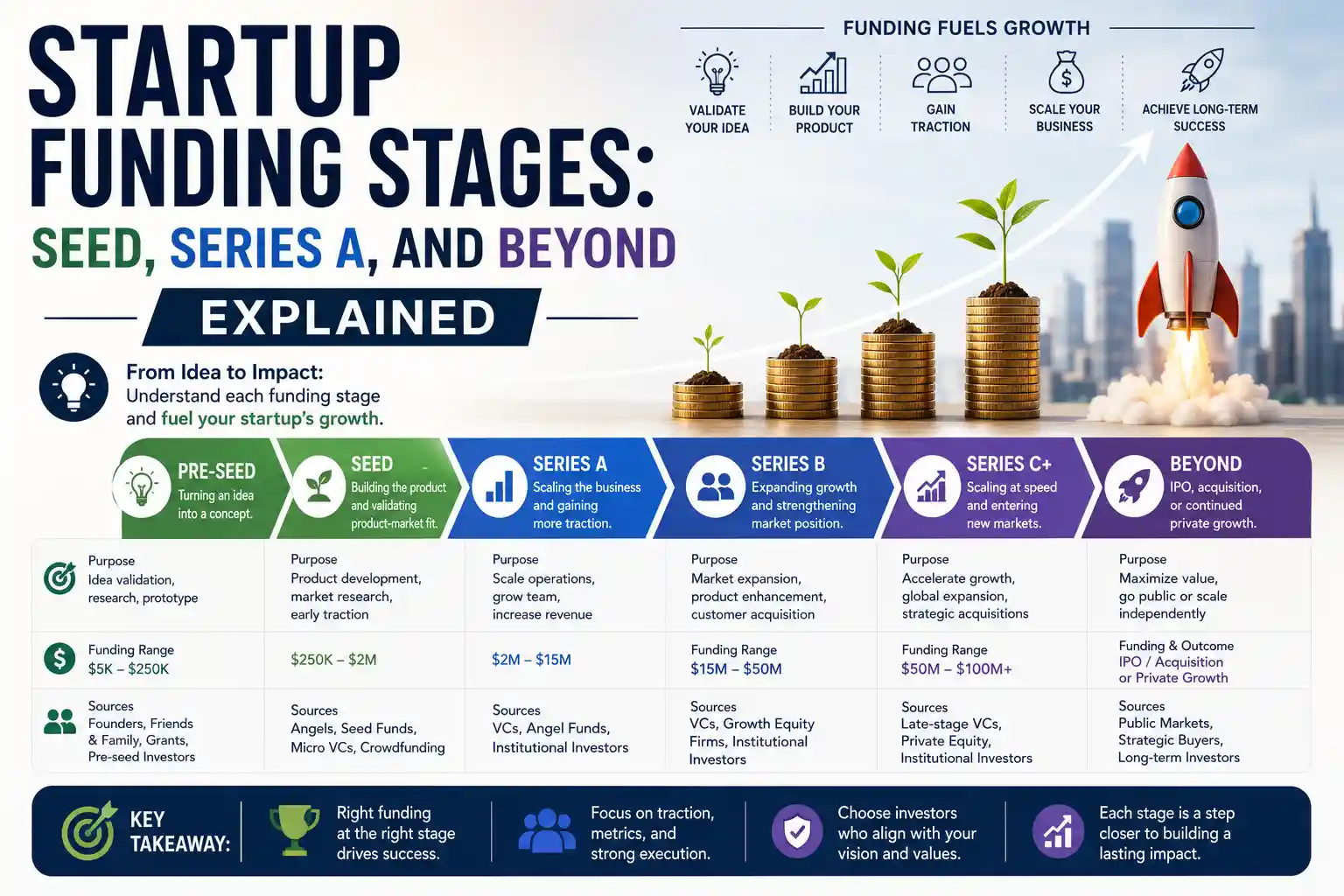
The most common startup funding stages are pre-seed, seed, Series A, Series B, and Series C, with some companies raising further rounds (Series D and beyond) or exiting through acquisition or IPO before reaching that point. Each stage funds a different phase: pre-seed and seed validate the idea and prove early demand, Series A funds structured growth once product-market fit is shown, and Series B and C fund expansion, scaling, and eventual preparation for a larger exit.
What Is Pre-Seed Funding?
Pre-seed is where an idea starts behaving like a business. At this stage, founders are typically working with a very small team — sometimes just themselves — and are developing a prototype or early proof of concept rather than a finished product.
Funding at this stage usually comes from personal savings, friends and family, or occasionally an angel investor or incubator backing the team as much as the idea itself. Most pre-seed rounds fall somewhere between $100,000 and $250,000, covering essentials like early product development, market validation, and forming a small, capable founding team.
Because pre-seed is a relatively new and informal part of the startup lifecycle, not every company raises a distinct pre-seed round — some go straight to seed once they have enough to show.
What Is Seed Funding?
Seed funding is often the first “real” institutional money a startup raises. The name is fitting: it’s the capital meant to help the business grow from an early idea into its first real steps, whether that’s completing product development, running deeper market research, or making initial hires.
The key difference from pre-seed is traction: seed-stage companies typically have a working product and at least some paying customers, while pre-seed companies are usually still validating their initial concept. Seed rounds are commonly backed by angel investors, early-stage venture capital firms, and sometimes accelerators, and the money is generally used to refine the product and begin proving demand in the market.
What Is Series A Funding?
Series A marks a shift. This is generally where startups move from friends-and-family-style funding into the world of institutional venture capital and “super angels.” Investors at this stage expect real evidence — enough metrics, customers, and traction to justify serious capital.
Series A funding typically focuses on scaling a proven business model, with rounds commonly ranging from $2 million to $15 million. To raise successfully, a startup usually needs a defensible valuation, which means investors will scrutinize company metrics, team strength, market size, and — most importantly — potential for continued growth.
The median time between a seed round and a Series A raise is roughly 18 months, though this varies significantly based on industry, growth rate, and market conditions.
What Is Series B Funding?
Series B funding supports operational expansion once a company has already demonstrated it can grow. This might mean hiring across departments, opening new offices, or expanding into new customer segments. Series B rounds typically range from $15 million to $25 million.
By this stage, investor expectations shift again: it’s no longer just about proving the idea works, but about showing the business can scale efficiently and sustainably. Series B investors tend to focus heavily on growth rate, market position, and a credible path toward profitability.
What Is Series C Funding (and Beyond)?
Series C funding generally supports larger, more ambitious moves — international expansion, acquisitions of smaller companies, or preparation for an eventual exit through acquisition or IPO. Series C rounds typically range from $25 million to $100 million, though this varies widely by industry and company scale.
Some companies raise further rounds beyond Series C — Series D, E, and so on — particularly if they need additional capital before going public or choose to stay private longer. There’s no fixed number of rounds a company must raise; the path depends entirely on the business model, growth trajectory, and strategic goals.
What Happens After Series C?
Not every company follows the same path after later-stage funding. A few common outcomes include:
- Initial Public Offering (IPO) — the company lists shares on a public stock exchange, opening it up to public investors. This is one possible outcome, but it’s neither mandatory nor the right fit for every business.
- Acquisition — a larger company buys the startup outright, offering an exit for founders and early investors without going public.
- Continued private funding — some companies simply keep raising additional private rounds (Series D, E, F, and beyond) rather than pursuing a public listing.
- Sustained profitability without further raises — a smaller number of companies reach a stage where they no longer need outside capital and can grow from their own revenue.
How Does Equity Dilution Work Across Funding Rounds?
Each time a startup raises a new round, founders typically give up a percentage of ownership in exchange for capital. On average, founders give up somewhere between 10% and 25% of equity per major funding round, though this varies significantly based on valuation, company progress, and market conditions.
Maintaining founder ownership above 50% through Series A is common, but this becomes progressively harder to sustain through later rounds as cap tables expand with each new round of investors. This is one reason many founders think carefully about how much to raise at each stage — raising more than necessary can mean giving up more control than the business actually needs.
Why Do Startup Funding Stages Matter for Founders?
Understanding these startup funding stages isn’t just academic — it directly shapes how founders should plan and pitch.
- Sets realistic expectations: knowing what investors expect at each stage prevents founders from pitching for capital they aren’t yet positioned to raise.
- Improves fundraising timing: raising too early, before enough traction exists, often leads to weaker terms or outright rejection.
- Clarifies use of capital: each stage is tied to a specific purpose, which helps founders build a credible plan for how funds will actually be used.
- Shapes investor conversations: pre-seed investors and Series B investors look for very different things, so pitches should be tailored accordingly.
- Helps track dilution over time: understanding typical equity given up per round helps founders plan how much control they’re likely to retain long-term.
Common Mistakes to Avoid Across Startup Funding Stages
- Raising a round before you have the traction that stage typically requires, which often leads to poor terms or wasted fundraising effort.
- Raising more capital than the business actually needs, resulting in unnecessary dilution.
- Pitching Series A investors with a pre-seed-level story, without the metrics and market evidence they expect.
- Ignoring how funding stage shapes investor type — some investors specialize in specific stages and simply won’t engage outside their focus.
- Treating an IPO as the default goal, when many successful companies exit through acquisition or stay private indefinitely.
Expert Tips for Navigating Startup Funding Stages
- Build financial visibility early — clean bookkeeping and expense tracking make later fundraising conversations far smoother and build investor confidence.
- Benchmark your metrics against typical expectations for your target round before pitching, so you know whether you’re actually ready.
- Remember that funding rounds aren’t a fixed checklist — plenty of successful companies skip stages, raise smaller “bridge” rounds, or exit before reaching later rounds at all.
- Track your dilution across rounds carefully; understanding your cap table trajectory helps you negotiate future rounds with clearer eyes.
Frequently Asked Questions
What’s the difference between pre-seed and seed funding? Pre-seed typically funds the earliest idea and prototype stage, often from personal networks, while seed funding generally requires a working product and some paying customers, and comes from more formal angel or early-stage VC investors.
How much equity do founders typically give up in a funding round? Founders commonly give up between 10% and 25% of equity per major round, though this depends heavily on valuation, traction, and negotiating position.
Do all startups need to raise venture capital? No. Many businesses grow successfully through bootstrapping, revenue, or smaller funding sources, and venture capital is best suited to businesses aiming for very rapid, large-scale growth.
How long does it typically take between funding rounds? This varies, but the median time between a seed round and Series A is roughly 18 months, with later rounds often spaced further apart depending on growth rate and market conditions.
What happens if a startup can’t raise its next funding round? Outcomes vary — some companies extend their runway through smaller bridge rounds, some pivot their strategy, and others are acquired or wind down if they can’t reach sustainable growth or profitability in time.
Conclusion
Startup funding stages exist to match capital to a company’s actual level of proof and readiness — from an early idea at pre-seed, to demonstrated demand at seed, to scalable growth from Series A onward. Understanding what each of these startup funding stages requires helps founders raise at the right time, with the right investors, for the right reasons.
There’s no single correct path through these stages — only the one that matches your business model, your market, and how much capital your growth actually requires.