
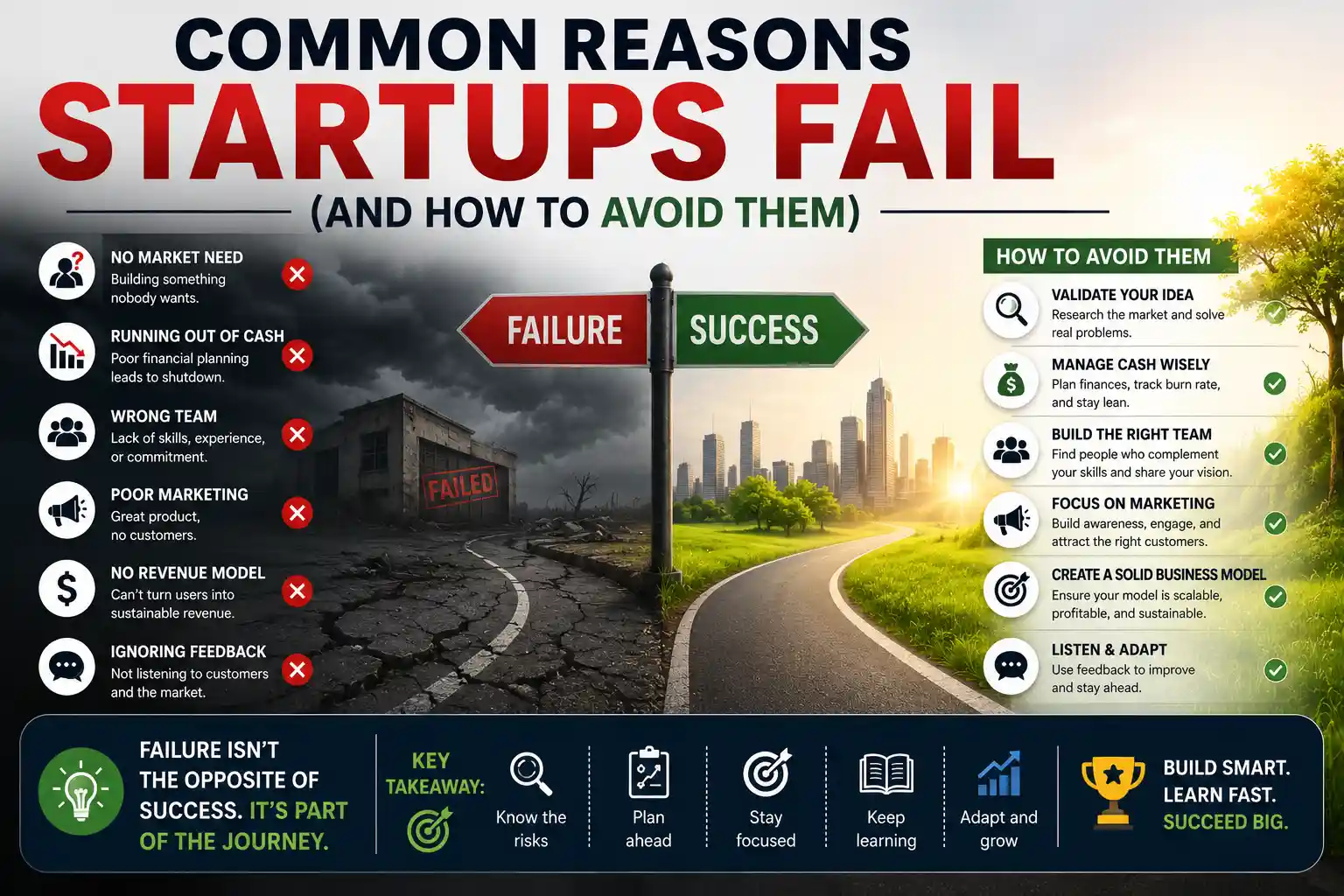
The startup world is full of survivorship bias — headlines celebrate the billion-dollar exits, but rarely mention the far larger number of companies that quietly shut down along the way. Understanding why startups fail isn’t pessimism; it’s one of the highest-leverage things a founder can study, because the patterns behind failure repeat far more often than they’re random.
Bureau of Labor Statistics data shows roughly 20% of new businesses fail within their first year and about 49% within five years. Venture-backed startups attempting rapid, scalable growth fail at even higher rates. But the specific causes are well documented, and — more usefully — largely preventable if you know what to watch for.
This guide breaks down the most common reasons startups fail, backed by post-mortem research, and what founders can actually do to avoid becoming another statistic.
Why Do Most Startups Fail?
Most startups fail because of poor product-market fit — building something the market doesn’t urgently need — which is often disguised as “running out of cash” by the time the company actually shuts down. Other leading causes include getting outcompeted, team conflict or the wrong hires, weak go-to-market execution, and premature scaling before the business model is proven.
What Does the Data Actually Say About Why Startups Fail?
CB Insights’ widely cited research, based on an analysis of hundreds of startup post-mortems, offers some of the clearest data available. Their most recent large-scale study of 431 failed VC-backed companies found:
- Poor product-market fit — cited in roughly 43% of failures
- Bad timing — around 29%
- Unsustainable unit economics — around 19%
- Team conflict or the wrong team — cited in roughly 23% of cases
- Running out of capital — the final, visible cause in about 70% of cases
That last figure is the one most people repeat, but it’s important to understand it as a symptom rather than a root cause. Startups don’t usually run out of cash randomly — they run out because the product isn’t generating enough revenue or growth to justify continued investment. Since companies often cite multiple contributing causes, these percentages add up to more than 100%.
An independent analysis by Failory, based on interviews with over 80 failed founders, found a similar pattern from a different angle: marketing problems topped their list at 56%, followed by team issues (18%) and finance (16%) — reinforcing that demand-side problems, not just financial mismanagement, tend to sit at the root of most failures.
What Are the Most Common Reasons Startups Fail?
1. Building something nobody urgently needs
This is consistently the single largest cause of startup failure. A product can be well-built and well-designed and still fail if it doesn’t solve a problem people are willing to pay to fix. Founders often mistake early enthusiasm from friends or casual users for real market demand, only to discover later that nobody was willing to actually pay for the solution.
2. Running out of cash
While frequently cited as the immediate cause of shutdown, running out of money is typically the endpoint of a longer chain of problems — weak product-market fit, poor unit economics, or slow revenue growth that never caught up to spending. The median time from a startup’s last fundraise to shutdown is around 22 months, and a notable share of failed companies spend years as “walking dead” before officially closing.
3. Getting outcompeted
Entering a market without a clear, defensible advantage — or without differentiating enough from competitors — leaves startups vulnerable to being outmaneuvered by better-funded or better-positioned rivals. This is especially common when founders skip deep competitive research before launch.
4. Team conflict and hiring mistakes
Founding team conflict is cited in roughly 23% of failures. Startups with a single founder tend to raise less capital and show lower survival rates on average than those with two or three co-founders. Hiring decisions made in a company’s first 20 employees also disproportionately shape culture and strategic direction for years afterward — getting them wrong early is expensive to fix later.
5. Bad timing
Entering a market too early — before customers understand or want the solution — or too late, after the opportunity has been captured by others, both show up repeatedly in post-mortem data. Startups entering markets too early often spend significantly more on customer education than those entering categories with already-established demand.
6. Unsustainable unit economics
A business can have plenty of customers and still fail if it costs more to acquire and serve each one than that customer generates in revenue. This is a particularly dangerous failure mode because growth can look impressive on the surface while quietly burning cash faster than it should.
7. Weak go-to-market execution
Having a good product isn’t enough if nobody hears about it. A lack of a clear customer acquisition strategy — or badly underestimating customer acquisition cost — shows up as a leading cause in independent founder surveys, separate from the CB Insights dataset.
8. Premature scaling
The Startup Genome Report identifies premature scaling — hiring, spending, or expanding faster than the business’s actual traction supports — as the primary cause of failure in a majority of high-growth startups that collapse. Scaling before a business model is proven tends to amplify existing weaknesses rather than solve them.
9. Failing to adapt to market feedback
Leadership’s inability to adjust strategy based on real customer feedback is a recurring theme even among otherwise well-funded companies. Notably, poor product-market fit isn’t only a seed-stage problem — some companies cite it as a primary cause of failure even after raising a Series B or later.
How Can You Avoid Becoming a Startup Failure Statistic?
There’s no guaranteed formula for success, but several practices consistently correlate with stronger survival odds.
- Validate demand before building extensively. Testing whether people will pay for a solution can often be done for very little money and time — far cheaper than building a full product first.
- Watch unit economics closely, not just growth. Track customer acquisition cost against lifetime value regularly, not just total user numbers.
- Build a complementary founding team. Diverse, aligned co-founders with clear roles tend to outperform solo founders and mismatched teams on survival.
- Study your competitors seriously. Understand not just who else exists in your space, but what would make customers choose you over them.
- Resist scaling before you’re ready. Confirm consistent traction and sustainable economics before significantly increasing spend or headcount.
- Revisit your strategy based on real feedback. Treat customer signals as data to act on, not just information to note and move past.
- Extend your runway deliberately. Since cash exhaustion is usually the final symptom of deeper problems, managing burn rate carefully buys time to fix the actual issue.
Why Does This Matter?
Studying startup failure isn’t about dwelling on worst-case outcomes — it’s a practical tool for better decision-making.
- It sharpens early-stage priorities: knowing that product-market fit failure dominates the data reinforces why validation should come before heavy investment.
- It reframes “running out of cash” correctly: treating it as a symptom, not a root cause, pushes founders to fix the underlying issue rather than just chase more funding.
- It improves team decisions: awareness of how much team conflict contributes to failure encourages more deliberate co-founder and early-hire choices.
- It informs fundraising timing: understanding how premature scaling contributes to failure helps founders resist raising and spending faster than their traction supports.
- It builds resilience: recognizing these patterns early gives founders a better chance to course-correct before problems become fatal.
Common Mistakes to Avoid
- Treating “ran out of money” as the real cause, instead of digging into what caused the cash to run out in the first place.
- Ignoring competitive research, assuming a good product alone is enough to win a crowded market.
- Scaling spend and headcount before traction is proven, rather than confirming the business model first.
- Avoiding co-founder conflict instead of addressing it directly, letting unresolved tension quietly damage decision-making.
- Dismissing early warning signs from customer feedback because they conflict with the founder’s original vision.
Expert Tips
- Revisit your product-market fit signals periodically, even after a successful funding round — fit can erode as markets and competitors shift.
- Track “time as walking dead” honestly; if growth and revenue have stalled for an extended period, it’s worth confronting that directly rather than continuing on the same path.
- When evaluating whether to scale, weigh consistency of traction over a period of months, not just a single strong week or month.
- Build a habit of comparing customer acquisition cost against lifetime value on a regular cadence, not just when raising a new round.
Frequently Asked Questions
What is the single biggest reason startups fail? Poor product-market fit — building something the market doesn’t urgently need — is the most consistently cited root cause across multiple large-scale studies.
Is “running out of cash” really the top reason startups fail? It’s the most visible immediate cause, cited in around 70% of shutdowns, but researchers generally treat it as a symptom of deeper issues like weak demand or poor unit economics rather than a root cause on its own.
Do team problems really cause a significant share of startup failures? Yes — team conflict or the wrong team composition is cited in roughly 23% of post-mortems, and solo founders tend to have lower survival rates on average than multi-founder teams.
Can a well-funded startup still fail from poor product-market fit? Yes. Some companies that fail from weak product-market fit have already raised Series B or later rounds, showing that funding alone doesn’t guarantee lasting demand for the product.
How can founders reduce the risk of running out of cash? Managing burn rate carefully, extending runway where possible, and tracking unit economics closely all help — but the most effective fix is addressing the underlying demand or growth problem before cash becomes the immediate crisis.
Conclusion
The reasons startups fail aren’t random or mysterious — they follow well-documented, repeatable patterns, with weak product-market fit sitting at the center of most of them. Running out of cash, team conflict, competitive pressure, and premature scaling all tend to compound around that same core issue.
Founders who study these patterns honestly — and act on early warning signs instead of dismissing them — give themselves a meaningfully better shot at building something that lasts.