
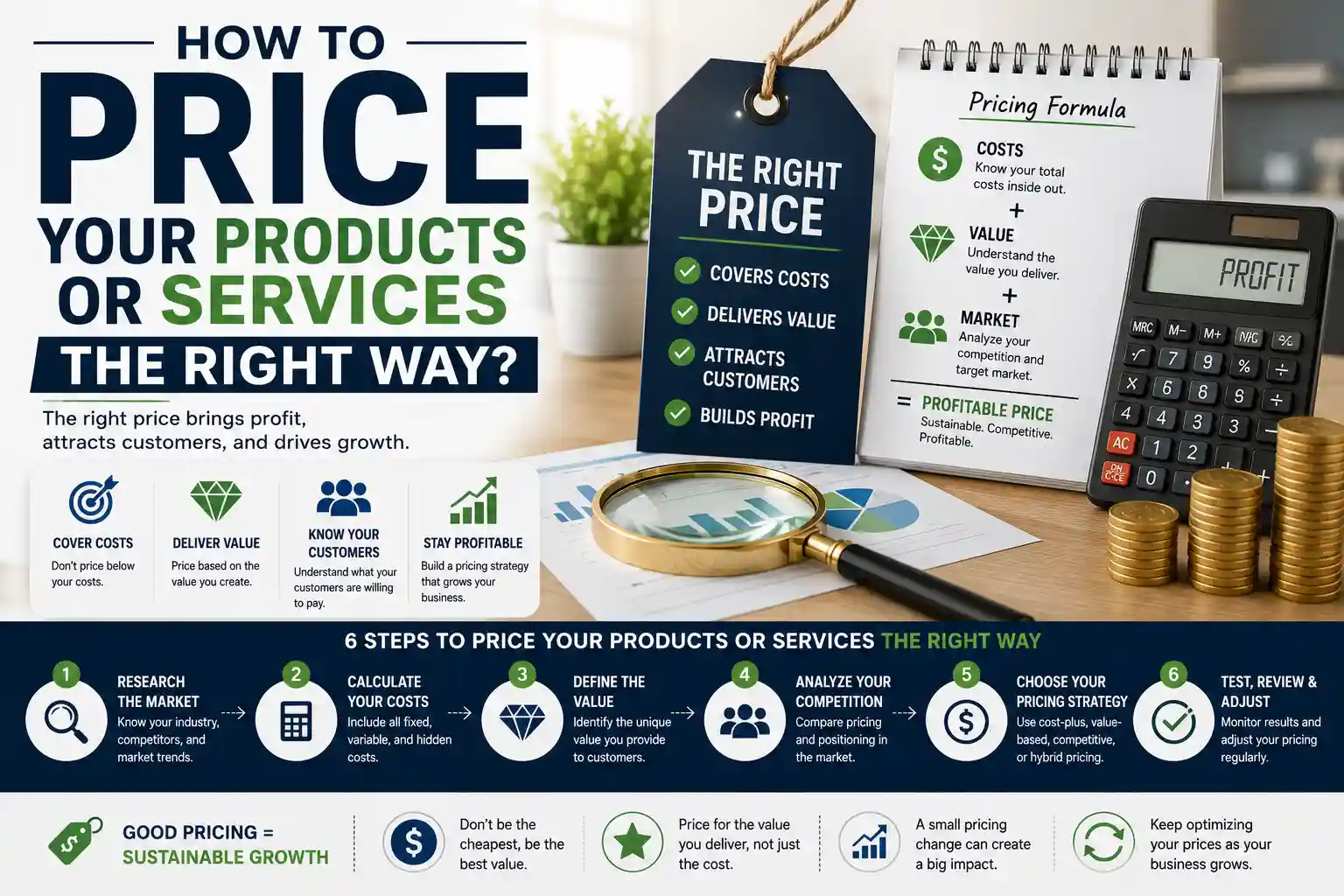
Pricing is one of the few business decisions that affects everything else at once — your revenue, your positioning, your customer perception, and your bottom line. Get it wrong, and even a great product can struggle to stay profitable.
A solid pricing strategy for small business owners isn’t about guessing a number that “feels right.” It’s a deliberate process built on real costs, market research, and customer value — one that gets revisited regularly instead of set once and forgotten.
This guide breaks down how pricing actually works, the most common strategies small businesses use, and a step-by-step process for setting — and adjusting — prices with confidence.
How Should Small Businesses Price Their Products or Services?
Start by calculating your true costs, including hidden ones like time and overhead, then research what competitors charge and what your target customers are willing to pay. From there, choose a pricing strategy — cost-plus, value-based, competitive, or a blend — that fits your business goals, and revisit your prices regularly rather than setting them once at launch.
Why Does Pricing Strategy Matter So Much?
Your price sends a signal before a customer ever experiences your product or service. It tells them whether you’re a budget option, a premium provider, or somewhere in between — shaping expectations before any interaction even begins.
Without a deliberate pricing strategy, businesses risk two costly mistakes: undercharging, which quietly erodes profit margins even as sales grow, or overcharging without justifying the value, which drives potential customers away. A pricing strategy gives you a framework for making informed decisions instead of guessing.
What Should You Understand Before Setting Any Price?
Know your true costs
Before exploring any pricing approach, you need a clear picture of what it actually costs to deliver your product or service. Many small business owners account for obvious costs — materials, supplies, wholesale prices — but overlook hidden ones like their own time, overhead, software, and delivery costs. If you don’t know your full costs, you can’t set a price that’s actually profitable.
Research your market
Look at what competitors charge for similar products or services, and understand how your offering compares. This isn’t about matching competitors exactly — it’s about knowing where you sit in the market so your pricing decision is informed rather than arbitrary.
Understand customer willingness to pay
Customers don’t evaluate price in a vacuum — they weigh it against the value they expect to receive. A client may happily pay more for a service delivered faster or with higher quality than competitors, especially if your positioning makes that value clear.
What Are the Most Common Small Business Pricing Strategies?
There’s no single “correct” pricing model — the right approach depends on your industry, costs, and business goals. Here are the strategies small businesses use most often.
1. Cost-plus pricing
Calculate your total cost to produce or deliver the product, then add a fixed markup. This is one of the simplest approaches and guarantees a profit on every sale, making it well suited to product-based businesses with predictable, stable costs.
2. Value-based pricing
Set prices based on the value the customer perceives, rather than strictly on your costs. This approach can maximize profit when customers clearly see high value in what you offer, though it requires strong messaging to communicate that value — and can mean higher marketing costs to establish it.
3. Competitive pricing
Set your price relative to what competitors in your market charge. This approach helps you stay grounded in market reality, but leaning on it too heavily can leave money on the table if your product genuinely offers more value than competitors.
4. Penetration pricing
Enter the market with lower prices than competitors to attract customers quickly and build market share, with the intention of adjusting prices upward later. This is a popular approach for startups and new small businesses trying to establish an initial customer base.
5. Price skimming
Set prices high during a product’s initial launch phase, then gradually lower them as competitors enter the market or demand shifts. This works well when a product offers a genuine early advantage that justifies a premium.
6. Bundling
Offer multiple products or services together at a combined price lower than buying each separately. Bundling increases perceived value and encourages customers to buy more, while also simplifying the purchase decision.
7. Freemium pricing
Offer a basic version of your product for free, then charge for advanced features or premium tiers. This model works well for software or digital products, giving customers a low-risk way to experience value before committing to pay.
How Do You Choose the Right Pricing Strategy for Your Business?
Start with your business model. Product-based businesses with predictable, stable costs often do well with cost-plus pricing, while service businesses — where value varies more by client and outcome — often benefit more from value-based pricing.
Next, consider your competitive landscape. In a crowded market with many similar options, competitive pricing helps you stay realistic, but if your offering is genuinely differentiated, leaning too hard on competitor pricing can undersell your actual value.
Finally, think about your growth stage. Newer businesses trying to build an initial customer base sometimes lean toward penetration pricing, while established businesses with a strong reputation and proven value can often sustain premium or value-based pricing more easily. Many businesses ultimately blend multiple strategies — research suggests companies using a balanced combination of pricing approaches can meaningfully outperform those relying on just one method.
How Often Should You Review Your Pricing?
Many small business owners set prices once at launch and rarely revisit them — a costly mistake, since costs, markets, and the value you deliver all change over time. A practical review cadence looks like this:
- Monthly: review your costs and margins for any unexpected increases eating into profit.
- Quarterly: compare your prices against competitors to see if the market has shifted.
- Annually: conduct a comprehensive pricing review to confirm your strategy still aligns with your business goals and brand positioning.
- After major changes: revisit pricing whenever you add new products, enter new markets, or experience a significant shift in costs.
How Do You Raise Prices Without Losing Customers?
Price increases are sometimes necessary, but how you handle them matters as much as the increase itself.
- Add value alongside the increase — introduce new features, better packaging, or improved service when you raise prices, so the change feels justified.
- Test incrementally — a series of small increases (5–10%) is generally easier for customers to absorb than one large jump.
- Communicate clearly — explain the reasoning behind the change rather than letting customers discover it unexpectedly.
- Stand firm on fair pricing — some pushback is normal, and if your pricing is fair and your value is clear, most customers will stay.
Why Does Getting Pricing Right Matter for Long-Term Success?
Pricing isn’t just an operational detail — it has a compounding effect on the health of the business.
- Protects profit margins: a clear pricing strategy prevents the slow erosion that comes from underpricing out of habit or fear.
- Shapes customer perception: price signals quality and positioning before a customer ever experiences the product.
- Reduces vulnerability to price wars: businesses built on value and loyalty are less exposed to competitors undercutting on price alone.
- Improves financial predictability: understanding true costs and margins makes forecasting and planning far more reliable.
- Supports sustainable growth: pricing that reflects real value gives a business room to reinvest, rather than operating on razor-thin margins indefinitely.
Common Mistakes to Avoid
- Setting prices too low out of fear of losing customers, which can raise doubts about quality and erode margins simultaneously.
- Ignoring hidden costs like time, overhead, and delivery when calculating your baseline price.
- Competing on price alone instead of building loyalty through quality and service that support higher margins.
- Never revisiting pricing after the initial launch, even as costs and market conditions change.
- Raising prices with no added value or explanation, which increases the risk of customer pushback and churn.
Expert Tips for Smarter Pricing
- Conduct customer feedback surveys, ideally with a small incentive, to understand how customers actually perceive the value of your product or service.
- Track profitability by individual product or service line, not just overall revenue — some offerings may be quietly unprofitable even as total sales look healthy.
- Use A/B testing where possible to compare how different price points affect conversion and revenue before committing to a permanent change.
- Make pricing review a scheduled habit, not a reactive decision made only when margins are already suffering.
Frequently Asked Questions
What is the simplest pricing strategy for a small business?
Cost-plus pricing is generally the simplest to calculate, since it’s based directly on your production costs plus a fixed markup, making it a reasonable starting point for product-based businesses.
How do I know if my prices are too low? .
Signs include consistently thin profit margins despite steady sales, customers expressing surprise that your prices are “so cheap,” or an inability to reinvest in the business after covering costs.
Should small businesses compete on price with larger competitors?
Generally not as a primary strategy. Larger competitors often have cost advantages small businesses can’t match, so building loyalty through quality, service, and differentiated value tends to be more sustainable.
How often should I raise my prices?
There’s no fixed schedule, but reviewing pricing at least annually — and after any major cost or market change — helps ensure prices keep pace with your actual costs and the value you provide.
Is value-based pricing risky for a new business?
It can be more challenging early on, since it depends on customers already recognizing your value, which takes time and strong messaging to establish — but it can also support stronger margins once that value is clearly communicated.
Conclusion
A strong pricing strategy for small business owners isn’t a one-time decision — it’s an ongoing process built on real costs, market awareness, and a clear understanding of the value you provide. Whether you lean toward cost-plus, value-based, competitive, or a blended approach, the goal is the same: prices that keep the business profitable while accurately reflecting what customers are getting.
Set aside time to review your pricing regularly, and treat it as a strategic decision — not a number you set once and hope holds up.