
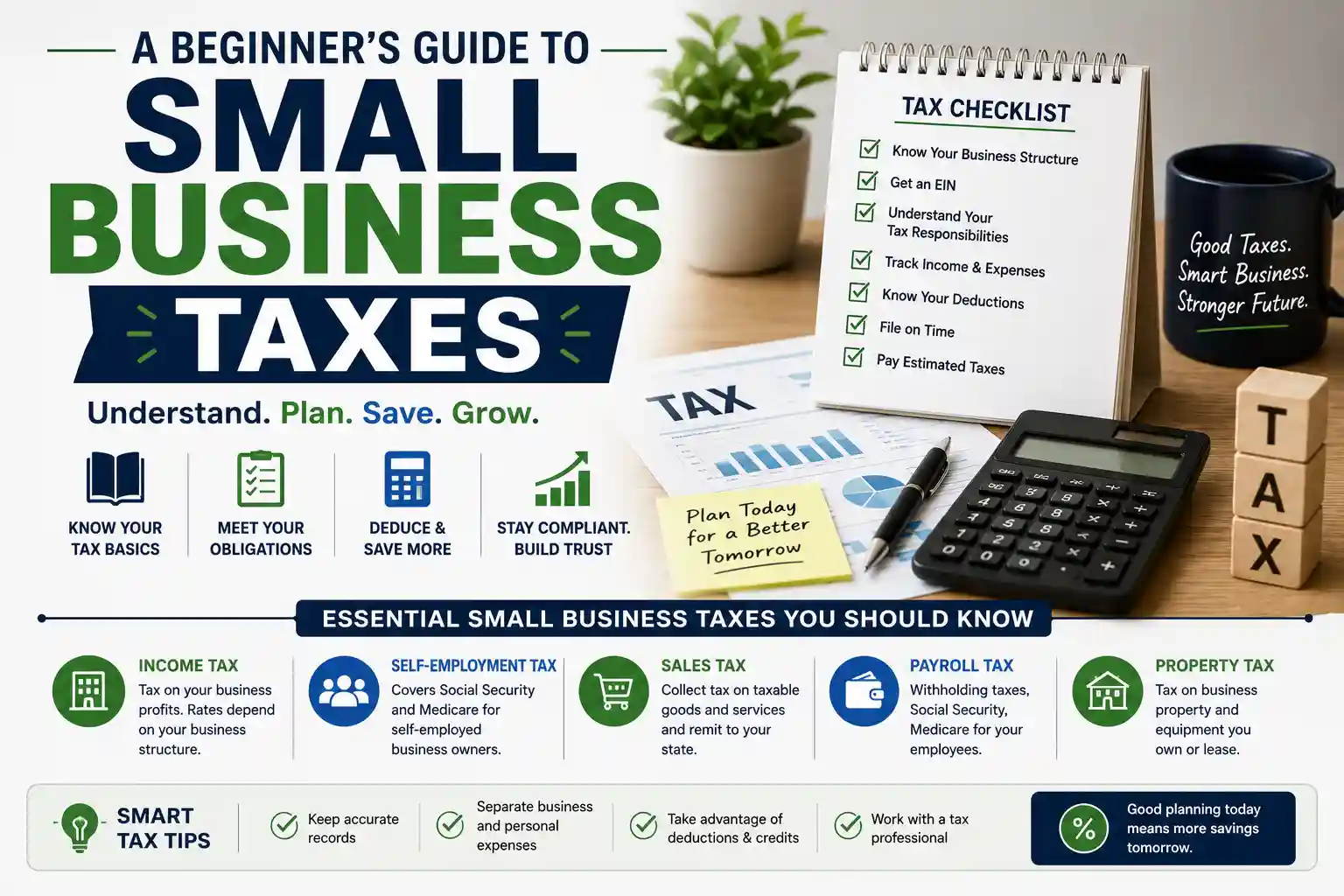
Few parts of running a business cause as much quiet dread as tax season. Between business structures, quarterly payments, and a long list of possible deductions, it’s easy to feel like you need an accounting degree just to stay compliant.
This small business taxes guide breaks the topic down into plain language — how your business structure affects what you owe, when payments are actually due, which deductions matter most, and how to stay organized so tax time doesn’t turn into a scramble.
This article is educational and general in nature, not personalized tax advice. Tax rules vary by location, business structure, and individual circumstances, so it’s worth confirming specifics with a qualified accountant or tax professional before filing.
What Do Small Business Owners Need to Know About Taxes?
Most small business taxes depend on three things: your business structure, your profit, and whether you have employees. Many small businesses are “pass-through” entities, meaning business income is reported on the owner’s personal tax return and subject to both income tax and self-employment tax. Most owners also need to make quarterly estimated payments throughout the year, track deductible expenses continuously, and file annual returns by deadlines that vary based on entity type.
How Does Your Business Structure Affect Your Taxes?
The IRS doesn’t use a single definition of “small business” — instead, it looks at your specific business structure and the forms you use to report income. Your structure determines how income is taxed and what forms you’ll file.
- Sole proprietorships report business income directly on the owner’s personal tax return, and profits are subject to self-employment tax in addition to regular income tax.
- Partnerships report income on a separate partnership return, but the tax liability passes through to each partner’s personal return.
- S corporations also pass income through to owners’ personal returns, but may offer some self-employment tax advantages depending on how compensation is structured.
- LLCs can be taxed as a sole proprietorship, partnership, or corporation, depending on elections made with the IRS, giving owners some flexibility.
Whether you’re a full-time business owner or a gig worker with a side hustle, you’re generally considered a business owner for tax purposes as soon as you start earning independent income — even before you’ve formally registered anything.
What Is Self-Employment Tax, and Who Pays It?
If you’re a sole proprietor, partner, or active LLC member, you typically owe self-employment tax in addition to regular income tax. This tax covers your contributions to Social Security and Medicare, since you don’t have an employer withholding these on your behalf.
The self-employment tax rate is 15.3%, covering both the Social Security and Medicare portions, with an additional Medicare tax applying above certain income thresholds. This is on top of — not instead of — your regular income tax obligation, which is why many new business owners are surprised by how much they owe in their first year.
What Are Quarterly Estimated Taxes, and Why Do They Matter?
Unlike traditional employees, whose taxes are withheld automatically from each paycheck, business owners are generally required to estimate and pay their taxes throughout the year rather than in one lump sum. This is where quarterly estimated taxes come in.
Most business owners must make estimated payments four times a year, generally in April, June, September, and January of the following year. Filing your annual tax return and making estimated tax payments are two separate obligations — it’s easy to assume they’re the same thing, but missing quarterly payments can result in penalties even if your annual return is eventually filed correctly.
A practical way to manage this is to set aside a percentage of income regularly — often suggested as roughly 25–30% for many small business owners — into a separate account specifically for taxes, so quarterly payments don’t create a cash flow surprise.
What Deductions Can Reduce What You Owe?
Tax deductions lower your taxable income, which can meaningfully reduce what you owe. The IRS generally allows deducting any expense considered “ordinary and necessary” for running the business. Common deductible categories include:
- Vehicle and mileage expenses for business-related travel
- Home office expenses, if part of your home is used regularly and exclusively for business
- Software and business tools used to run day-to-day operations
- Marketing and advertising costs
- Professional services, such as legal or accounting fees
- Business insurance premiums
- Equipment and supplies used directly in the business
- Retirement plan contributions, which reduce taxable income while building savings
It’s worth understanding the difference between deductions and credits: deductions reduce taxable income before your tax bill is calculated, while credits reduce your final tax bill directly, dollar for dollar.
What Is the Qualified Business Income (QBI) Deduction?
Many pass-through business owners — sole proprietors, partnerships, S corporations, and certain LLCs — may qualify for the Qualified Business Income deduction under Section 199A, allowing eligible owners to deduct up to 20% of their qualified business income. This has become significant for many small business owners’ overall tax liability, though certain service-based businesses may face income-based limitations on how much they can claim.
Because eligibility and phase-out thresholds can be complex, this is an area where a tax professional can help ensure you’re claiming everything you’re entitled to.
How Do You Stay Organized for Tax Time All Year?
Waiting until tax season to organize your finances is one of the most common — and most stressful — mistakes small business owners make. A few habits make a real difference:
- Use accounting software consistently to record transactions as they happen, rather than reconstructing months of activity later.
- Separate business and personal finances with a dedicated business bank account and card, which simplifies tracking deductible expenses.
- Keep receipts and documentation for every deductible expense, since the IRS requires proof to support claims.
- Track mileage and travel in real time using a log or app, rather than estimating after the fact.
- Set aside money for taxes regularly, ideally in a separate account, so quarterly payments don’t create cash flow strain.
- Review your numbers monthly, not just at tax time, so you catch issues or opportunities early.
What Are Common Tax Deadlines?
Deadlines vary based on your business structure, so it’s important to know which applies to you:
- Partnerships and S corporations typically file earlier in the tax season than sole proprietors.
- Sole proprietors and single-member LLCs generally file alongside personal tax returns.
- Quarterly estimated payments are generally due in April, June, September, and January, regardless of entity type.
- Extensions are available for annual filings, but they extend the time to file — not the time to pay what’s owed, so estimated payments are still expected on schedule.
Because exact dates shift slightly year to year based on weekends and holidays, it’s worth confirming current deadlines directly with the IRS or a tax professional each year.
Why Does This Matter?
Getting a handle on your tax obligations isn’t just about compliance — it directly protects your bottom line.
- Avoids penalties: missing quarterly payments or filing deadlines can trigger costly interest and penalties that eat into profit.
- Maximizes legitimate deductions: understanding what qualifies means you’re not overpaying simply out of uncertainty.
- Improves cash flow planning: knowing what you’ll owe and when prevents unpleasant surprises that can strain the business.
- Builds credibility: clean, organized financial records make it easier to secure loans, attract investors, or sell the business later.
- Reduces stress: a predictable, organized system turns tax season into routine, rather than an annual scramble.
Common Mistakes to Avoid
- Mixing personal and business finances, which makes tracking deductible expenses far more difficult and error-prone.
- Ignoring quarterly estimated payments until a large tax bill arrives at year-end, along with penalties for underpayment.
- Failing to keep documentation for deductions, which can mean losing them entirely if you’re ever audited.
- Assuming all business structures are taxed the same way, when in reality your entity type significantly changes your obligations.
- Waiting until tax season to organize records, instead of building simple habits throughout the year.
Expert Tips for Managing Small Business Taxes
- Set aside a percentage of every payment received — automatically, if possible — into a dedicated tax savings account so you’re never caught short.
- Review your entity structure periodically with a tax professional; as your business grows, a different structure may offer meaningful tax advantages.
- Don’t wait until year-end to talk to an accountant — a mid-year check-in can surface opportunities to adjust before it’s too late to act.
- Keep a simple, consistent system for documentation from day one; retrofitting a messy year of records is far more time-consuming than staying organized as you go.
Frequently Asked Questions
Do all small business owners have to pay quarterly estimated taxes? Most self-employed individuals and business owners without an employer withholding taxes on their behalf are required to make quarterly estimated payments, though some can adjust withholding from a spouse’s W-2 job to help cover this instead.
What’s the difference between a tax deduction and a tax credit? A deduction reduces your taxable income before your tax bill is calculated, while a credit reduces your final tax bill directly, dollar for dollar, after your tax liability is determined.
Can I deduct my home office if I work from home? In many cases, yes — if part of your home is used regularly and exclusively for business purposes, though specific requirements and calculation methods apply, so it’s worth reviewing with a tax professional.
What happens if I miss a quarterly estimated tax payment? Missing a quarterly payment can result in penalties and interest, even if your annual tax return is filed correctly and on time, since the payments are treated as separate obligations.
Do I need an accountant for small business taxes, or can I file myself? It depends on the complexity of your business. Many small business owners with straightforward finances use accounting software and file confidently on their own, but businesses with employees, multiple income streams, or complex deductions often benefit from professional guidance.
Conclusion
Small business taxes can feel overwhelming at first, but the fundamentals are learnable: understand how your structure affects your obligations, stay on top of quarterly payments, track deductible expenses consistently, and don’t wait until tax season to get organized.
With the right habits — and professional support where needed — small business taxes become a predictable part of running your business, not a source of year-round stress.