
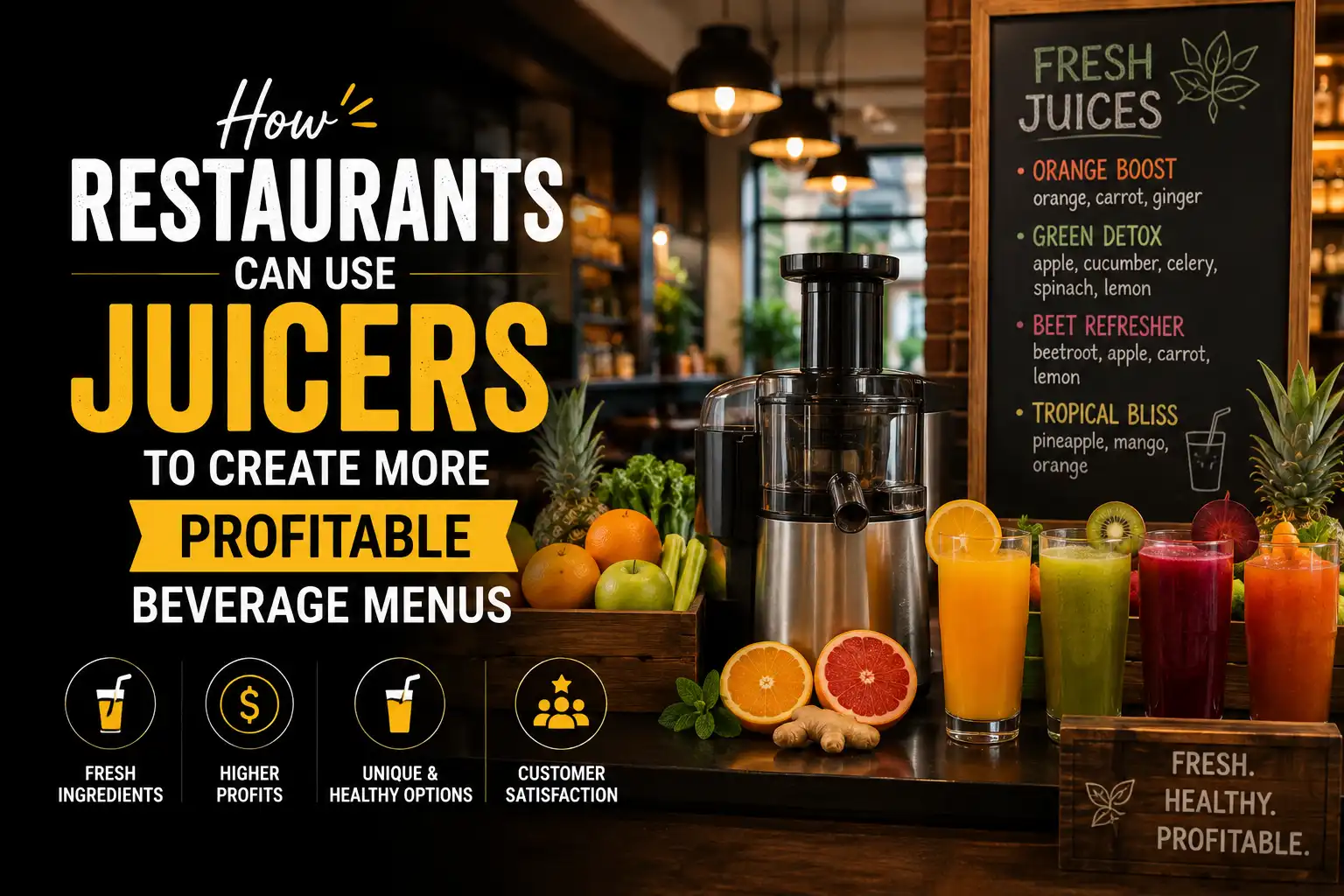
When was the last time you looked at your restaurant’s beverage menu and thought about it as a genuine growth opportunity?
For many restaurant owners, drinks sit quietly on the menu while most of the attention goes toward food, chefs, and ingredients. Yet beverages can have a surprisingly important role in increasing the average order value and giving customers another reason to visit.
Fresh juice is particularly interesting because it can turn relatively simple ingredients into something that feels special. A glass of freshly prepared juice can become a breakfast favorite, a colorful brunch drink, a sophisticated mocktail, or even the base for a signature cocktail.
Of course, buying a juicer and adding “fresh juice” to the menu is not a business strategy by itself. To make the idea work, restaurants need to think about ingredients, pricing, customer preferences, preparation time, waste, and workflow.
Here are some practical ways entrepreneurs can turn fresh juice into a profitable part of their restaurant concept.
Build a Flexible Menu Around Seasonal Ingredients
One of the easiest mistakes a restaurant can make is creating an enormous juice menu that requires dozens of different ingredients.
More choices can sound appealing, but too much variety can quickly create problems. More ingredients mean more storage, more preparation, more complicated recipes, and potentially more food waste.
Instead, focus on a smaller selection of versatile fruits and vegetables that can be used in several drinks.
For example, oranges can become fresh orange juice, a citrus mocktail, a breakfast blend, or part of a cocktail. Apples can be combined with carrots, cucumber, ginger, or beetroot. Watermelon can become a refreshing summer juice or the base of a seasonal mocktail.
A few combinations worth testing include:
- Orange, carrot, and ginger
- Apple, cucumber, and mint
- Beetroot, apple, and lemon
- Watermelon and lime
- Pineapple, cucumber, and ginger
Seasonality can make the menu even more interesting.
Rather than offering exactly the same drinks throughout the year, introduce limited-time combinations. Watermelon and mint might work beautifully during summer, while apple, pear, and ginger could take its place when temperatures drop.
There is a marketing advantage here too. A “new seasonal juice” gives regular customers a reason to check the menu again. It also gives your social media team something fresh to talk about.
Local produce can make the idea even stronger. If your restaurant is located near farms or a region known for particular fruits and vegetables, consider featuring them. Customers often enjoy knowing where their food comes from, and travelers may see a local juice as part of the destination experience.
Don’t Stop at Traditional Juice
Here’s where having a good juicer can become much more valuable.
Freshly extracted juice does not have to be sold only as a glass of juice.
It can become the foundation for mocktails, cocktails, spritzes, brunch beverages, wellness-inspired drinks, and seasonal specials.
Imagine that grapefruit is one of the ingredients you already have in your kitchen. You could serve freshly squeezed grapefruit juice at breakfast. Add sparkling water and herbs, and suddenly you have a sophisticated non-alcoholic drink. Combine it with spirits and bitters, and it can become a cocktail.
One ingredient, several menu possibilities.
This approach is particularly useful because restaurant customers have different expectations depending on when they visit. Someone stopping in for breakfast might want something refreshing and simple, while an evening guest may be looking for an interesting cocktail.
Presentation can also influence perceived value.
A beautiful glass, fresh herbs, a citrus twist, or a carefully chosen garnish can make a relatively simple drink feel much more premium. And let’s be honest, presentation matters even more now that customers routinely photograph their meals.
A memorable drink can end up on Instagram or TikTok, putting your restaurant in front of people who have never visited.
The important thing is not to confuse creativity with complexity. A drink containing twelve ingredients might look impressive on paper but become a headache during a busy Saturday night.
The best restaurant drinks often have something in common: they look complicated to the customer but are surprisingly efficient for the staff to prepare.
Price Your Drinks for Profit, Not Just Popularity
A drink can sell extremely well and still make very little money.
This is easy to overlook when developing a fresh juice program. Restaurant owners naturally focus on the price of the ingredients, but the real cost includes much more.
There is produce, labor, preparation, equipment, refrigeration, storage, cleaning, electricity, garnishes, and waste to consider.
That is why consistent recipes are so important.
If one employee uses three oranges for a drink and another uses five, your ingredient costs can become unpredictable. Standardizing recipes helps maintain both consistency and profitability.
Portion size matters too. A huge glass may look impressive, but it is not necessarily the most profitable option. A carefully portioned drink can still feel generous when it is presented well.
Ingredient cross-utilization is another strategy worth considering.
If you buy mint for one specialty juice but never use it anywhere else, some of that inventory may end up in the trash. If the same mint is used in several drinks and perhaps a few dishes, it becomes much easier to manage.
Before adding a new beverage, ask yourself:
“Where else can we use these ingredients?”
If the answer is several places, the drink is likely to be easier to incorporate into your existing operation.
The equipment itself should also be treated as part of the financial equation. Before buying a machine, restaurant owners can research comparisons such as best premium cold press juicers compared to understand differences in capacity, durability, cleaning requirements, extraction, and overall suitability for commercial use.
The most expensive machine is not automatically the best choice. The right equipment is the one that fits your actual volume and workflow.
Choose Equipment That Fits Your Restaurant
A great beverage concept will struggle if the equipment cannot keep up with demand.
There is no universal “best” juicer for every restaurant. A busy breakfast café has very different requirements from a small cocktail bar or wellness-focused restaurant.
Centrifugal juicers are often associated with fast preparation, which can be useful in high-volume environments. Masticating juicers operate more slowly and can be appealing for businesses that want versatility with different fruits and vegetables. Dedicated commercial citrus juicers can also make sense when orange, lemon, or grapefruit juice is central to the menu.
When choosing equipment, look beyond the headline specifications.
Think about:
- How quickly can employees prepare a drink?
- How easy is the machine to clean?
- Can it handle your expected daily volume?
- How much counter space does it require?
- Is it noisy during service?
- How easy are replacement parts and maintenance?
- Can new employees learn to use it quickly?
That last point is easy to underestimate.
A machine might produce excellent juice, but if employees find it frustrating to operate or clean, it can slow down service. During a busy brunch, nobody wants a complicated piece of equipment becoming the bottleneck behind the counter.
Workflow should feel straightforward:
Prepare. Juice. Serve. Clean. Repeat.
If that process works smoothly, your staff can focus on customers rather than fighting with equipment.
And there is no need to launch a huge juice program immediately. Start with three or four signature drinks. Watch what customers actually order. Then adjust the menu based on real sales rather than assumptions.
Make Fresh Juice Part of the Customer Experience
The most effective restaurant beverage programs do more than sell drinks. They give customers something to remember.
A fresh juice can become part of someone’s morning routine. A signature mocktail can become the reason a group chooses your restaurant for brunch. A seasonal drink can bring regular customers back because they want to try something new.
For entrepreneurs focused on attracting more customers, this is where fresh juice becomes interesting.
It is not simply another item to add to the menu. It is an opportunity to experiment with local ingredients, seasonal flavors, presentation, and new experiences without completely changing your food offering.
The trick is to keep the concept practical.
You do not need twenty different juices. You need a handful of drinks that taste good, look appealing, make financial sense, and can be prepared consistently.
Then pay attention to what your customers tell you through their behavior.
Which drinks sell quickly? Which ones are ignored? Which ones appear in customers’ photos? Which flavors do people ask for again?
Those answers can help you refine the menu far better than simply following the latest beverage trend.
Conclusion
A commercial juicer can be much more than another appliance behind the restaurant counter.
When used thoughtfully, it can help restaurants turn everyday fruits and vegetables into premium beverages that increase order value, attract health-conscious customers, create seasonal excitement, and give people another reason to return.
The key is to think about the entire beverage strategy, not just the machine.
Choose versatile ingredients, take advantage of seasonal produce, experiment with mocktails and cocktails, control portions and costs, and select equipment that fits your actual workflow.
Most importantly, give customers something worth remembering.
A great meal might convince someone to visit once. A distinctive restaurant experience, complete with a fresh drink they genuinely enjoyed, can give them a reason to come back.