
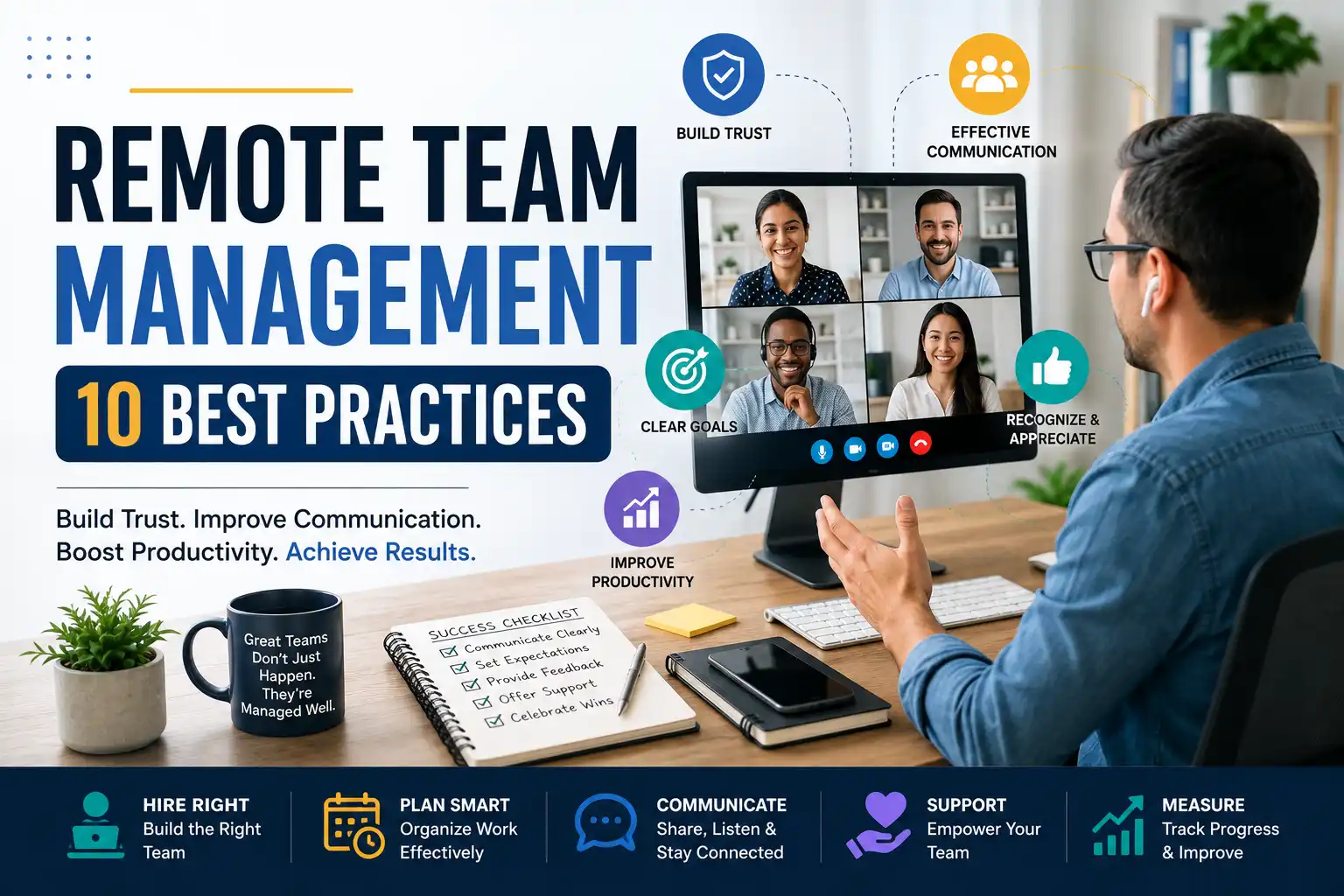
Leading a team you never see in person is a different job than leading one down the hall. Priorities get lost in chat threads, time zones split the workday, and people can quietly disengage without anyone noticing.
This is the core challenge of remote team management: keeping people aligned, productive, and connected when physical proximity is no longer part of the equation. The good news is that this challenge has a solution — and it isn’t more meetings.
With clear structure, the right communication habits, and a bit of empathy, distributed teams can perform just as well as (or better than) in-office ones. This guide breaks down what remote team management actually involves, the biggest challenges managers face, and the practices that separate thriving remote teams from struggling ones.
Quick Answer: What Does Effective Remote Team Management Look Like?
Effective remote team management means replacing physical presence with clear systems: defined goals, predictable communication rhythms, the right collaboration tools, and a results-first mindset. Instead of watching hours logged, managers track outcomes, hold regular check-ins, and build trust through transparency rather than supervision.
What Is Remote Team Management?
Remote team management is the practice of leading employees who work from different locations — sometimes different countries and time zones — without relying on a shared office to keep everyone aligned.
It goes beyond scheduling video calls. It involves rethinking how information flows, how work gets tracked, and how a manager builds trust with people they may rarely meet face to face. Done well, it gives employees more autonomy while still holding the team accountable to shared goals.
Why the Shift From “Presence” to “Outcomes” Matters
In a traditional office, a manager could gauge effort by who was at their desk. Remote work removes that visual cue entirely.
This forces a mindset shift: managing by outcomes instead of hours. Instead of tracking when someone logs in, a manager measures what they deliver, how consistently, and how well it matches agreed priorities.
This shift requires:
- Clearly defined goals and success metrics
- Regular but lightweight check-ins
- Enough autonomy for employees to organize their own schedules
- Trust that work will get done, even when it isn’t being watched
What Are the Core Challenges of Managing Remote Teams?
Distributed teams face a distinct set of obstacles that rarely show up in a traditional office setting. Understanding them is the first step to solving them.
- Isolation and weaker team cohesion. Without hallway chats or shared lunches, employees can start to feel disconnected from colleagues and the company itself.
- Communication breakdowns. Written messages lack tone and context, which increases the risk of misunderstandings — especially across time zones.
- Time zone friction. Handoffs stall when one person is asleep while another is waiting on a reply.
- Blurred work-life boundaries. Without a commute or a fixed office schedule, employees often struggle to log off, raising the risk of burnout.
- Unclear ownership. When roles and responsibilities aren’t spelled out in writing, tasks slip through the cracks.
- Limited access to support. Remote employees can find it harder to reach IT help, HR, or informal mentorship compared to in-office staff.
How Can Managers Build Trust Without Physical Presence?
Trust is the foundation of remote leadership. Since managers can’t observe work happening in real time, they need to build confidence through structure rather than surveillance.
This starts with setting clear expectations from day one — defined deliverables, deadlines, and quality standards that leave little room for ambiguity. When expectations are explicit, employees don’t need to guess what “good work” looks like.
It also means resisting the urge to micromanage. Constant check-ins and monitoring software often backfire, signaling distrust and pushing employees to disengage rather than perform.
What Are the Best Practices for Managing Remote Teams?
The strongest remote managers rely on a handful of repeatable habits rather than one-off fixes. Here are the practices that consistently show up across well-run distributed teams.
1. Set clear goals and success measures
Write down one to three specific, measurable goals for each cycle, and assign a single owner to each. Vague priorities are one of the most common causes of wasted effort in remote teams.
2. Establish a predictable communication rhythm
Employees shouldn’t have to guess when they’ll hear from their manager. A simple structure works well:
- A short async status update at the start of the week
- One or two synchronous team meetings for alignment
- Regular one-on-one check-ins for individual support
- A dedicated space for documenting decisions
3. Master asynchronous communication
Not every conversation needs to happen live. Written updates — clear, structured, and easy to skim — reduce dependency on meetings and let people work through overlapping time zones without waiting on each other.
4. Protect the right to disconnect
Remote work can quietly erase the line between “on the clock” and “off.” Managers should avoid messaging outside agreed hours and encourage employees to set visible boundaries, such as status indicators or quiet hours.
5. Build a feedback and recognition culture
Remote employees lose the informal cues — a nod, a quick comment — that tell them their work is on track. Regular, specific feedback fills that gap and keeps motivation high.
6. Invest in onboarding
A structured onboarding process — covering tools, documentation, and introductions to teammates — helps new remote hires become productive faster and reduces early confusion.
7. Choose the right tools, and use them with purpose
Tools alone don’t fix communication problems, but the right stack removes friction. Common categories include:
- Project management: for tracking tasks, deadlines, and ownership
- Messaging and video conferencing: for real-time collaboration
- Documentation platforms: for centralizing knowledge so nothing lives only in someone’s inbox
- Time tracking or workload dashboards: for spotting overload before it becomes burnout
Why Does Effective Remote Team Management Matter?
Strong remote team management isn’t just about avoiding problems — it directly affects business outcomes.
- Higher productivity: Employees with clear goals and fewer unnecessary meetings tend to get more done with less wasted effort.
- Better retention: People are far more likely to stay with an employer who supports flexible, well-managed remote work.
- Wider talent access: Companies that manage remote teams well can hire from a much larger pool, unrestricted by geography.
- Improved engagement: Structured communication and recognition reduce the isolation that often drives disengagement.
- Lower burnout risk: Clear boundaries and realistic workloads protect both performance and wellbeing over the long term.
How Do You Choose the Right Approach for Your Team?
There’s no single formula that works for every organization, but a few questions can guide your decisions.
Start by asking how much of the work genuinely requires real-time collaboration versus independent focus. Teams doing deep, individual work benefit from fewer meetings and stronger async habits, while teams with constant cross-functional dependencies may need more scheduled overlap time.
Next, consider your team’s time zone spread. A team clustered within a few hours of each other can lean more on live meetings; a globally distributed team should default to written, asynchronous updates.
Finally, match your tools to your actual workflow rather than picking whatever is popular. A small team may only need one messaging app and a shared task board, while larger, multi-project teams often benefit from an all-in-one platform that connects tasks, time, and reporting.
Common Mistakes to Avoid in Remote Team Management
- Micromanaging through excessive check-ins or monitoring software — this erodes trust faster than almost anything else.
- Leaving goals and responsibilities vague — ambiguity causes more damage remotely than it does in person.
- Overloading the calendar with meetings — not every update needs a live call.
- Ignoring cybersecurity basics for home offices — unsecured Wi-Fi and personal devices create real risk without clear guidelines like VPN use and multi-factor authentication.
- Treating culture as something that only happens in an office — without deliberate effort, remote teams can drift apart from company values.
Expert Tips for Stronger Remote Leadership
- Start meetings with context, not status — save status updates for written channels and use live time for decisions and problem-solving.
- Keep a simple, shared decision log so no one has to dig through old chat threads to understand why a call was made.
- Rotate informal virtual social time (coffee chats, casual check-ins) so relationship-building doesn’t disappear.
- Review workload distribution regularly — remote burnout often builds quietly before it becomes visible.
Frequently Asked Questions
What is the biggest challenge in remote team management? Most managers point to communication breakdowns and employee isolation as the toughest challenges, since both are harder to spot without in-person cues.
How do you handle time zone differences when managing a remote team? Rely on asynchronous updates, document decisions in writing, and schedule a small overlap window for essential live discussions rather than forcing everyone into one time zone.
What tools are essential for remote team management? A project management platform, a messaging or video conferencing tool, and a shared documentation space cover most of the day-to-day needs of a distributed team.
How often should remote teams have check-ins? A weekly team sync plus regular one-on-ones works well for most teams — frequent enough to stay aligned, without turning into constant supervision.
Can remote teams be as productive as in-office teams? Yes. Research consistently shows that with clear goals and the right systems, remote employees can match or exceed in-office productivity levels.
Conclusion
Remote team management isn’t about replicating the office online — it’s about building new systems suited to distributed work. Clear goals, predictable communication, the right tools, and genuine trust all matter more than physical presence ever did.
Managers who focus on outcomes, protect their team’s wellbeing, and communicate with intention will find that remote team management, far from being a compromise, can be a genuine advantage for building a productive, engaged, and resilient team.