
Winning a new customer feels great — until they disappear after one purchase and never come back. That’s the moment many businesses realize acquisition alone isn’t a growth plan.
This is where customer retention strategies come in. Instead of pouring every dollar into finding new buyers, retention-focused businesses invest in keeping the customers they already have — and it pays off. Repeat customers tend to spend significantly more than first-time buyers, and keeping an existing customer is far cheaper than acquiring a new one.
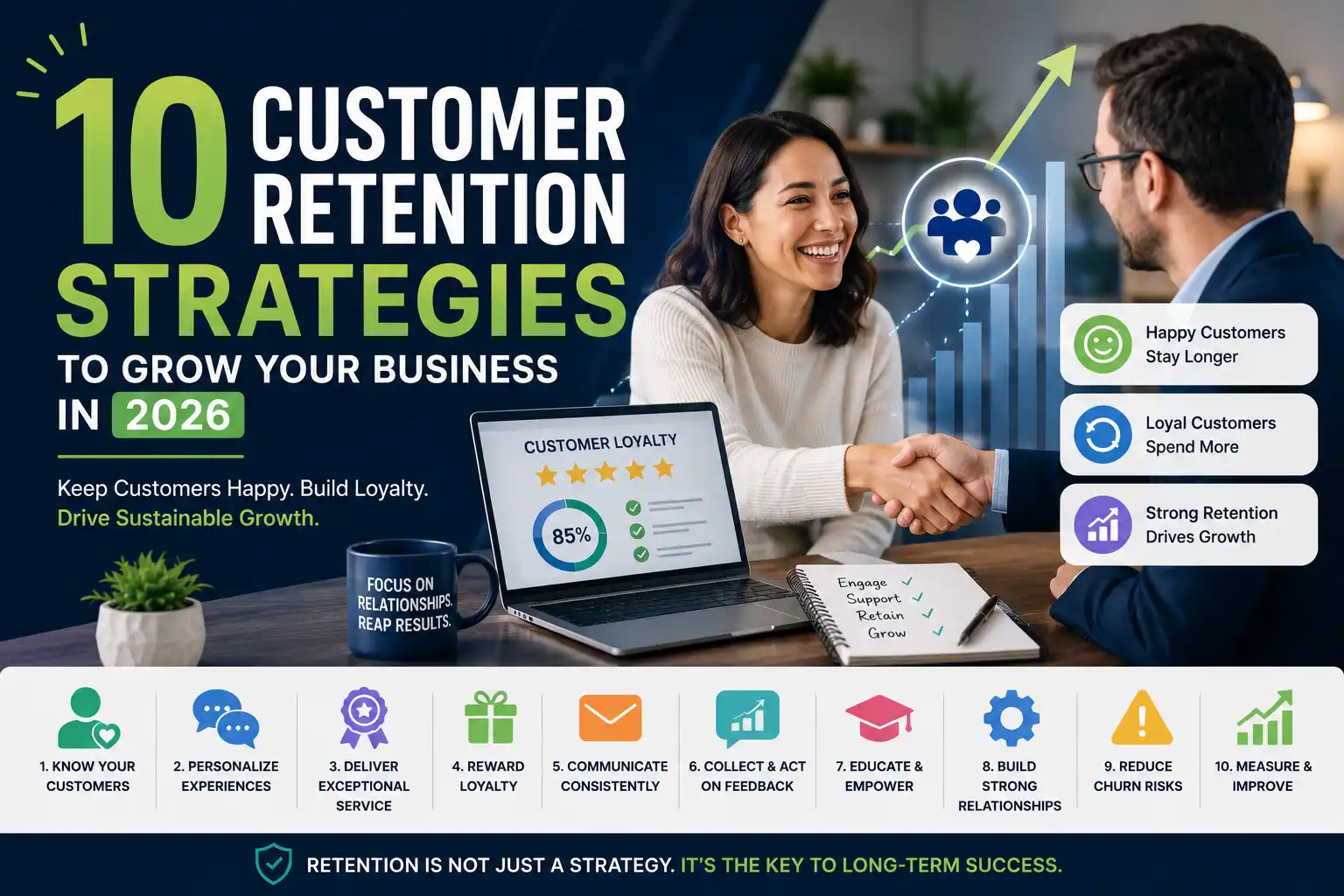
This guide breaks down what customer retention actually means, the metrics worth tracking, and ten practical strategies you can start using today to build loyalty and drive sustainable growth.
Quick Answer: What Are the Best Customer Retention Strategies?
The most effective customer retention strategies combine personalization, proactive support, loyalty rewards, and consistent communication. Businesses that personalize interactions, respond quickly across channels, act on customer feedback, and reward repeat behavior consistently see lower churn and higher customer lifetime value.
What Is Customer Retention and Why Does It Matter?
Customer retention is a business’s ability to keep existing customers engaged and coming back — through repeat purchases, renewals, or continued use — instead of losing them to competitors.
It’s the flip side of acquisition. Acquisition wins a customer’s first purchase; retention turns that customer into someone who buys again, renews their subscription, or upgrades their plan.
Retention matters because it directly affects the bottom line:
- It’s significantly cheaper than acquiring new customers
- Repeat customers spend more over time and are easier to upsell
- Loyal customers often refer friends and colleagues, lowering acquisition costs
- It creates more predictable, stable revenue for the business
What Metrics Should You Track for Customer Retention?
You can’t improve what you don’t measure. A handful of core metrics reveal whether your retention efforts are actually working.
- Customer Retention Rate (CRR) – the percentage of customers a business keeps over a given period.
- Customer Churn Rate – the percentage of customers who stop buying or using your product during a period. A high number signals dissatisfaction.
- Customer Lifetime Value (CLV) – the total revenue a business can expect from one customer over the full relationship.
- Repeat Customer Rate – the share of customers who’ve made two or more purchases.
- Purchase Frequency Rate – how often customers return to buy, typically measured annually to account for seasonality.
Tracking these side by side gives a fuller picture than looking at any single number alone, and it helps you judge whether your customer retention strategies are actually working.
What Are the Top 10 Customer Retention Strategies?
Below are ten proven strategies that consistently show up across businesses with strong retention numbers, from e-commerce brands to B2B software companies.
1. Build emotional connections with customers
Customers stay loyal to brands that make them feel recognized, not just billed. Use customer names in communication, celebrate milestones with a discount or thank-you note, and share content that genuinely resonates with their interests.
2. Offer omnichannel support
Customers expect to reach a business wherever they already are — social media, live chat, email, or phone — and get a consistent answer no matter the channel. Unifying support across platforms removes friction and keeps small issues from turning into lost customers.
3. Launch a loyalty or rewards program
Loyalty programs give customers a tangible reason to return. Options include:
- Points-based systems tied to spending
- Tiered rewards that unlock better perks over time
- Referral bonuses for bringing in new customers
- Early access to new products or exclusive events
A well-known example is a beauty retailer’s point-based program, where customers earn points per dollar spent and redeem them for products — a simple mechanic that keeps people coming back.
4. Streamline onboarding
A confusing first experience is one of the fastest ways to lose a new customer. Clear step-by-step guides, short explainer videos, or a touch of gamification can make onboarding smoother and reduce early drop-off.
5. Personalize every interaction
Most customers now expect experiences tailored to their preferences, and many are willing to share data to get them. Personalization can mean tailored product recommendations, localized content, or simply remembering a customer’s past interactions instead of making them repeat themselves.
6. Be proactive, not just reactive
Waiting for customers to complain is a losing strategy. Proactive retention means:
- Monitoring product or service usage to catch issues early
- Following up after a purchase to confirm satisfaction
- Reaching out before a renewal date with helpful information
- Flagging declining engagement before it turns into churn
7. Build a customer community
An online community — a forum, a private group, or a social space — gives customers a place to troubleshoot problems, share tips, and feel a sense of belonging to something bigger than a single transaction. Brands that do this well often turn customers into active advocates who help other customers too.
8. Collect and act on customer feedback
Feedback is only useful if it changes something. Combine short satisfaction surveys with more specific questions (for example, asking which support channel customers prefer) so you get insights precise enough to act on. Pair this with frontline input from support teams, who often spot patterns before anyone else does.
9. Use AI to strengthen customer service
AI-powered tools can flag churn risk earlier, recommend personalized offers, and provide instant answers to common questions at any hour. Used well, AI doesn’t replace human support — it clears routine work off agents’ plates so they can focus on complex or emotionally sensitive interactions.
10. Invest in employee experience
Employees who feel supported and well-trained tend to deliver better, more empathetic service — and customer-facing teams are often the deciding factor in whether a customer stays or leaves. Investing in training, incentives, and a healthy work environment pays off directly in customer loyalty.
Why Do Customer Retention Strategies Matter for Growth?
Retention isn’t just a support function — well-designed customer retention strategies act as a growth lever in their own right.
- Lower acquisition costs: retained customers reduce reliance on constant new-customer spending.
- Higher revenue per customer: repeat buyers are more open to upsells and cross-sells.
- Stronger word-of-mouth: satisfied, loyal customers refer others without being asked.
- More predictable revenue: high retention smooths out the ups and downs of relying purely on new sales.
- Competitive resilience: loyal customers are less likely to be won over by a competitor’s short-term discount.
How Do You Choose the Right Retention Strategy for Your Business?
Not every one of these customer retention strategies fits every business model, so it helps to think through a few questions before committing resources.
Start with your purchase cycle. Businesses with frequent, low-cost purchases (like e-commerce or food delivery) often see the biggest wins from loyalty programs and personalization, since customers interact often enough to notice the rewards. Subscription or B2B businesses, on the other hand, tend to benefit more from proactive support and strong onboarding, since renewal decisions hinge on ongoing value rather than single transactions.
Next, look at where you’re actually losing customers. If churn spikes right after onboarding, fix onboarding before investing heavily in a loyalty program. If customers drift away after months of use, proactive engagement and feedback loops will likely move the needle more.
Finally, match your retention efforts to the data you can realistically collect and act on. A small team may only be able to sustain one or two strategies well — and doing two things consistently beats doing five things halfheartedly.
Common Mistakes to Avoid in Customer Retention
- Treating retention as a one-time project instead of an ongoing, measured practice.
- Over-automating support to the point where customers never feel like they’re talking to a real person.
- Launching a loyalty program without tracking whether it changes behavior.
- Ignoring feedback collected through surveys instead of turning it into visible changes.
- Focusing only on discounts as a loyalty lever, which attracts price-sensitive customers rather than genuinely loyal ones.
Expert Tips for Stronger Customer Retention
- Segment your retention efforts — new customers, at-risk customers, and long-term loyalists all need different messaging.
- Respond fast, even if you can’t solve the issue immediately; a quick acknowledgment reduces frustration more than people expect.
- Review retention metrics by segment, not just as a company-wide average — a strong overall number can hide a shrinking group of unhappy customers.
- Recognize loyal customers publicly (with permission) — social proof from real customers is more persuasive than brand messaging.
Frequently Asked Questions
What are the most effective customer retention strategies? Personalization, proactive support, loyalty programs, and consistent omnichannel communication are consistently the strategies with the biggest measurable impact on retention rates.
How is customer retention different from customer acquisition? Acquisition focuses on winning a customer’s first purchase, while retention focuses on keeping that customer engaged and buying again over time. Both matter, but retention is typically far more cost-effective.
What is a good customer retention rate? This varies by industry and business model, but a strong retention rate generally sits well above 80%, with subscription businesses often expecting even higher numbers due to renewal cycles.
How can small businesses improve customer retention on a limited budget? Start with the lowest-cost, highest-impact moves: fast responses, personalized follow-ups, and a simple feedback loop. These require time and consistency more than large budgets.
Can AI really improve customer retention? Yes. AI tools can flag at-risk customers earlier, personalize recommendations at scale, and provide instant support around the clock, freeing human agents to focus on complex, high-value interactions.
Conclusion
Customer retention isn’t a single tactic — it’s a mindset built through consistent, well-executed customer retention strategies. Personalized experiences, proactive support, meaningful loyalty rewards, and a genuine willingness to act on feedback all compound over time.
Businesses that commit to these customer retention strategies don’t just reduce churn — they build a base of loyal customers who spend more, stick around longer, and bring new customers along with them.