
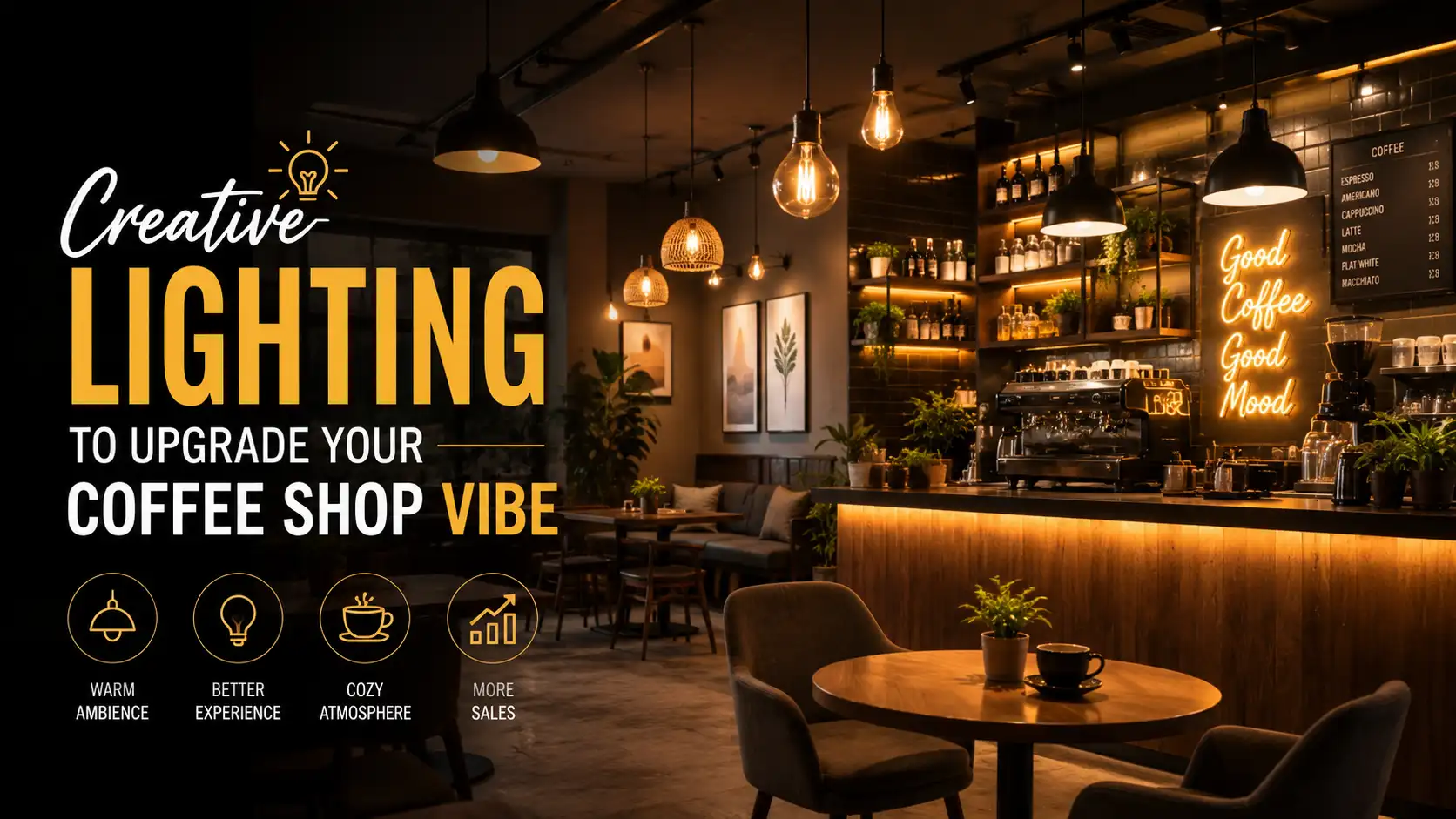
Lighting decides how long a customer stays in your coffee shop. It decides how your espresso looks in photos. It decides whether a first-time visitor comes back. Most café owners spend months picking the right beans and the right roast. Then they hang a few bare bulbs and call it done.
That’s a mistake. Lighting is not decoration. It’s a functional system that shapes mood, workflow, and spending behavior.
This guide breaks down how to build a lighting plan that actually works for a coffee shop, not a generic retail space.
Why Lighting Changes Customer Behavior
Light affects how people perceive time. Research published through the Journal of Consumer Psychology found that people in dimly lit spaces spent 16% more time at the table than people in brightly lit ones. For a coffee shop, that number matters. Longer stays usually mean a second order. They also mean more visibility for your space on social media, since people linger long enough to take photos.
The takeaway isn’t “make everything dark.” It’s that light intensity and color temperature directly control how a customer experiences your shop, minute by minute.
Layering Light Instead of Flooding It
Most café lighting fails for one reason. Owners install a single ceiling grid and stop there. That creates flat, even light with no character.
A better approach uses three layers:
- Ambient light. This is your baseline, usually recessed ceiling fixtures or track lighting. It should sit around 3000K to 3500K for a warm, welcoming tone without turning yellow.
- Task light. This covers the counter, the register, and the espresso bar. Task areas need higher output, closer to 4000K, so baristas can read tickets and steam wands accurately.
- Accent light. This is where personality lives. Pendant lights over tables, wall sconces near seating nooks, and signage all fall here.
Skipping the accent layer is the most common gap. It’s also the cheapest layer to fix.
Signage as a Light Source, Not an Afterthought
Wall signage does double duty. It brands the space and it lights it. A well-placed neon coffee signs fixture behind the counter or above a seating wall gives customers a built-in photo backdrop. It also fills a corner that overhead lighting usually misses.
Neon and LED-neon signage draws far less power than traditional neon gas tubes, so running one during full operating hours won’t spike your electric bill. Custom shapes let you match your logo or a simple phrase tied to your brand.
Place signage where a phone camera naturally points, near a window seat or a feature wall, not buried in a back corner.
Color Temperature by Time of Day
Coffee shops run on two very different rhythms. Morning traffic wants speed. Afternoon traffic wants to settle in.
Adjust your lighting to match:
- 6 a.m. to 11 a.m. Run brighter, cooler light near 4000K. It matches the energy of customers grabbing a quick order before work.
- 11 a.m. to 3 p.m. Shift to a moderate, balanced tone. This is your working crowd, laptops open, staying for an hour or more.
- 3 p.m. to close. Warm things up toward 2700K to 3000K. This supports the slower, social pace of late-afternoon and evening visits.
Dimmable fixtures and simple smart switches handle this without any rewiring. A basic dimmer module costs less than one week of specialty coffee sales.
Fixture Choices That Hold Up in a Café Environment
Coffee shops deal with steam, heat, and constant foot traffic near the counter. Fixture material matters as much as style.
Pendant lights with metal or ceramic shades handle heat better than plastic near espresso machines. Exposed filament bulbs look great but run hot, so keep them away from low ceilings where customers might brush against them. LED retrofit bulbs now match the warm glow of filament bulbs without the heat output or the energy draw, which makes them the safer long-term choice for high-traffic seating.
Building the Plan
Start with ambient light for baseline coverage. Add task lighting where precision matters. Then use accent lighting, including signage, to give the space identity. Adjust color temperature through the day instead of running one static setting from open to close.
None of this requires a full renovation. Most coffee shops can rework their lighting plan with new bulbs, a few added fixtures, and one signage piece, all within a weekend.
Good lighting doesn’t just make a coffee shop look better in photos. It changes how long people stay and how they remember the visit.