
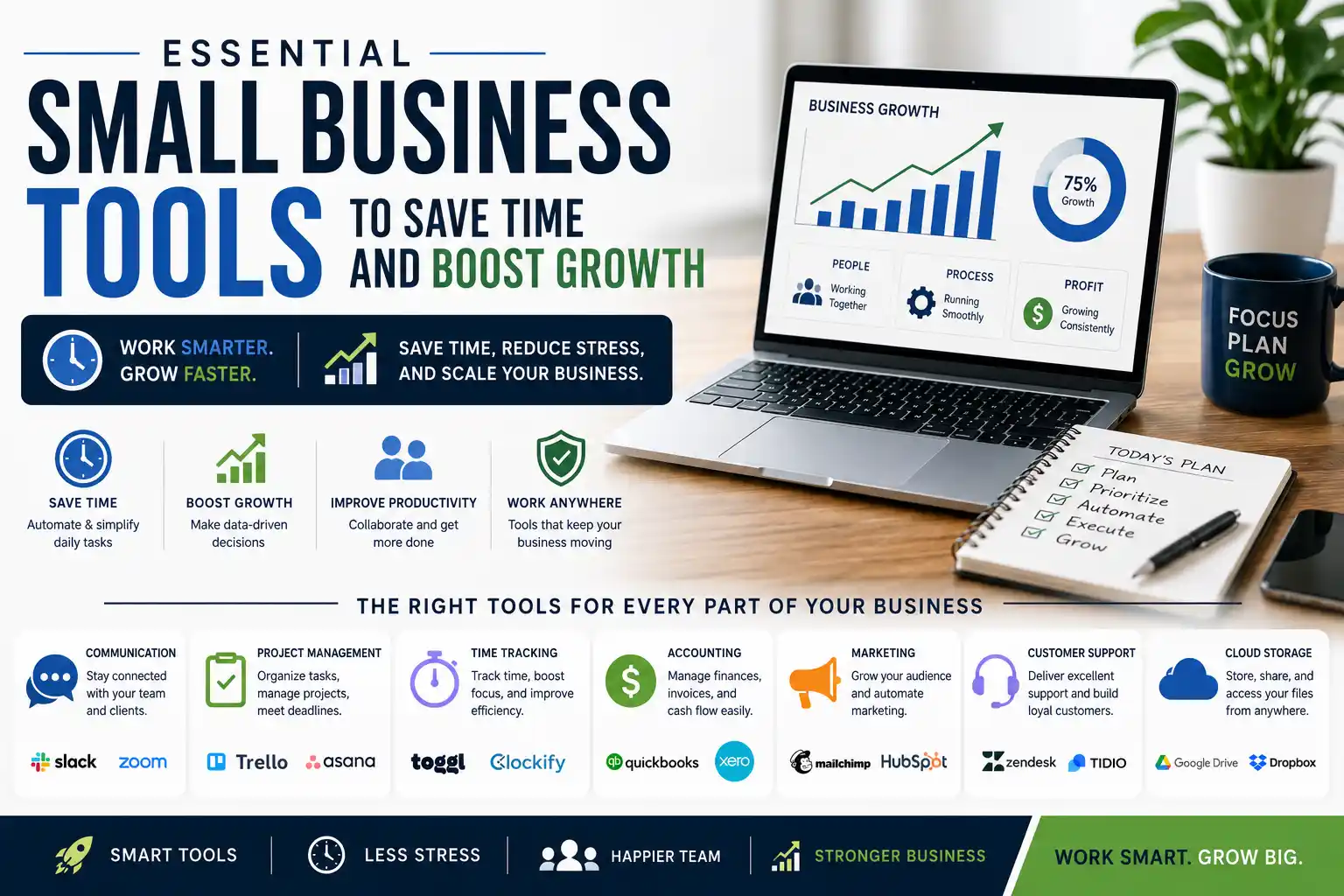
Running a small business often means wearing every hat at once — marketing, finance, HR, and customer service, sometimes all before lunch. Many small business owners work six or seven days a week just to keep up.
The right small business tools can take a huge chunk of that workload off your plate. From free project management boards to all-in-one management platforms, today’s tools let small teams operate with the efficiency of a much bigger company — without the bigger budget.
This guide breaks down what business management software actually does, the categories of tools worth prioritizing, and ten specific small business tools you can start using right away.
Quick Answer: What Are the Best Small Business Tools?
The best small business tools cover the core areas every business needs to manage: project management, communication, customer relationships, finance, and marketing. Popular starting points include Trello or Asana for tasks, Slack or Microsoft Teams for communication, HubSpot CRM for customer relationships, Wave or Xero for accounting, and Canva for design — most of which offer free or low-cost plans built specifically for small teams.
What Is Business Management Software?
Business management software is any application designed to automate routine tasks and streamline day-to-day operations, freeing owners and managers from time-consuming, low-value work.
These tools touch nearly every part of running a business — time tracking, workflow management, customer relationships, invoicing, and reporting. Instead of managing everything manually or from memory, small business tools centralize the work so nothing slips through the cracks.
Why Should Small Businesses Invest in These Tools?
A 2020 global survey found that roughly two-thirds of organizations across industries were piloting or had already adopted automation for at least part of their business processes — a trend that has only accelerated since.
The right tools deliver value in a few consistent ways:
- They save time so owners can focus on tasks that directly grow the business
- They reduce costly errors, missed deadlines, and lost information
- They improve customer retention through better service and follow-up
- They support remote and hybrid work by keeping teams connected regardless of location
- They give owners visibility into cash flow, performance, and team capacity
What Are the Best Small Business Tools by Category?
Below are ten categories of small business tools, along with well-regarded options in each, that consistently show up across recommendations for small teams.
1. Project management tools
If you’re juggling multiple tasks and deadlines, project management software keeps everyone aligned. Tools in this category typically offer boards, lists, or calendars to visualize work and automatically remind teams about upcoming deadlines.
- Trello — a visual, drag-and-drop board that’s especially intuitive for small teams
- Asana — offers list, board, and calendar views with task assignments and due dates
- Basecamp — combines project tracking with team communication in one place
2. CRM software
Customer relationship management tools give you a central hub to track every touchpoint with a customer, from first website visit to closed deal. A good CRM keeps contact data organized and accessible across your other tools.
- HubSpot CRM — a free option with contact management, deal tracking, and pipeline visibility
- Pipedrive — a deal-driven CRM known for its intuitive interface and mobile app
- Salesforce Essentials — a condensed version of Salesforce built specifically for small businesses
3. Workplace communication tools
As teams grow — or go remote — instant messaging and video conferencing become essential for staying connected without constant meetings.
- Slack — organizes conversations by channel, project, or topic and integrates with many other tools
- Microsoft Teams — combines chat, video calls, and file sharing within the Microsoft 365 ecosystem
- Zoom — a reliable option for video meetings, with free plans covering most small-team needs
4. Accounting and invoicing software
Managing finances is one of the most common pain points for small business owners. Accounting tools automate expense tracking, invoicing, and financial reporting so you’re not reconciling numbers by hand.
- Wave — free accounting software built for small businesses and freelancers
- Xero — handles expenses, invoicing, and inventory in one platform
- QuickBooks — offers a self-employed package for tracking expenses and estimating tax payments
5. Marketing and social media tools
Building a consistent brand presence takes time, but scheduling and design tools can dramatically cut down the hours spent on marketing tasks.
- Canva — a beginner-friendly design tool for social graphics, presentations, and marketing materials
- Hootsuite — schedules and analyzes social posts across multiple platforms from one dashboard
- Mailchimp — manages email campaigns with audience segmentation and performance tracking
How Do You Choose Between Individual Tools and an All-in-One Platform?
Small businesses generally have two paths: combine several specialized tools, or adopt a single platform that handles multiple functions together. Each approach has real trade-offs.
Using a combination of individual tools gives you flexibility to pick the best option in each category, and if one tool goes down, your other systems keep running. The downside is that costs can add up across multiple subscriptions, integration issues can crop up between tools, and switching between apps takes time. It can also introduce data inconsistencies when the same information lives in several places.
Using an all-in-one platform — such as a combined project management, CRM, and invoicing system — simplifies things considerably. You typically pay one predictable rate, reduce time spent duplicating data across systems, and give your team a single interface to learn instead of several. The main trade-off is that switching to an all-in-one platform can take longer upfront, especially if it needs to integrate with or replace legacy software you’re already using.
There’s no universally “right” answer — it depends on how complex your operations already are and how much time you’re willing to invest in setup.
Why Do Small Business Tools Matter for Growth?
Adopting the right small business tools isn’t just about convenience — it has a real, measurable impact on how a business runs and grows.
- More time for growth-focused work: automating routine tasks frees owners to focus on strategy, sales, and product
- Fewer costly mistakes: document and finance tools reduce the risk of lost records or missed payments
- Better customer relationships: CRM tools help you respond faster and remember details that build loyalty
- Improved team collaboration: communication and project tools keep remote or hybrid teams aligned
- Clearer financial visibility: accounting software gives owners real-time insight into cash flow and profitability
How Do You Choose the Right Tools for Your Business?
Start by identifying where you’re currently losing the most time or making the most mistakes — that’s usually the best place to introduce a new tool first. A business drowning in unorganized emails will benefit more from a CRM than from a fancier design tool.
Next, take advantage of free trials and free-tier plans before committing. Nearly every tool mentioned here offers some form of free access, which lets you test real workflows with your actual team before paying for anything.
Finally, think about how tools will work together. A project management app that integrates with your communication tool and cloud storage saves far more time than three disconnected systems that all do their own thing well but don’t talk to each other.
Common Mistakes to Avoid When Adopting Small Business Tools
- Buying tools before mapping your actual workflow — leading to features you never use.
- Choosing too many single-purpose tools without checking whether they integrate with each other.
- Ignoring free plans that would have covered your needs, and overpaying for premium tiers too early.
- Skipping team training, which leads to low adoption even after paying for a good tool.
- Never revisiting your toolkit as the business grows past the limits of a free or starter plan.
Expert Tips for Getting More Out of Small Business Tools
- Start with one category — communication or project management — rather than overhauling every system at once.
- Set a recurring calendar reminder to review your tool stack every quarter and cut anything the team isn’t actually using.
- Use integrations (like Zapier or Make) to connect tools that don’t talk to each other natively, rather than manually copying data between them.
- Assign one team member as the “owner” of each tool so questions and setup issues have a clear point of contact.
Frequently Asked Questions
What free tools should every small business start with? Trello or Asana for tasks, Slack for communication, Google Workspace for documents and email, and a free CRM like HubSpot are a strong, low-cost starting stack.
Is it better to use one all-in-one platform or several separate small business tools? It depends on your team size and complexity. Small, simple operations often do fine with an all-in-one platform, while businesses with more specific needs may get more value from combining specialized tools.
How much should a small business spend on software tools? Many core small business tools offer usable free tiers, so it’s reasonable to start at little to no cost and only upgrade to paid plans once a tool proves its value to your workflow.
What’s the most important tool category for a brand-new small business? Communication and basic project management tend to deliver the fastest return, since they immediately reduce confusion and missed tasks as soon as more than one person is involved.
Do small business tools really save money, not just time? Yes. Beyond the time saved, tools like CRM software improve customer retention, cash flow software helps avoid costly financial surprises, and document management tools prevent expensive errors from lost information.
Conclusion
The right small business tools do more than tidy up your task list — they free up time, reduce costly mistakes, and give you the visibility needed to make better decisions as you grow. Whether you build a stack of specialized apps or invest in an all-in-one platform, the goal is the same: spend less time managing the business and more time growing it.
Start small, pick tools that solve your most pressing pain point first, and expand your small business tools as your needs evolve.