
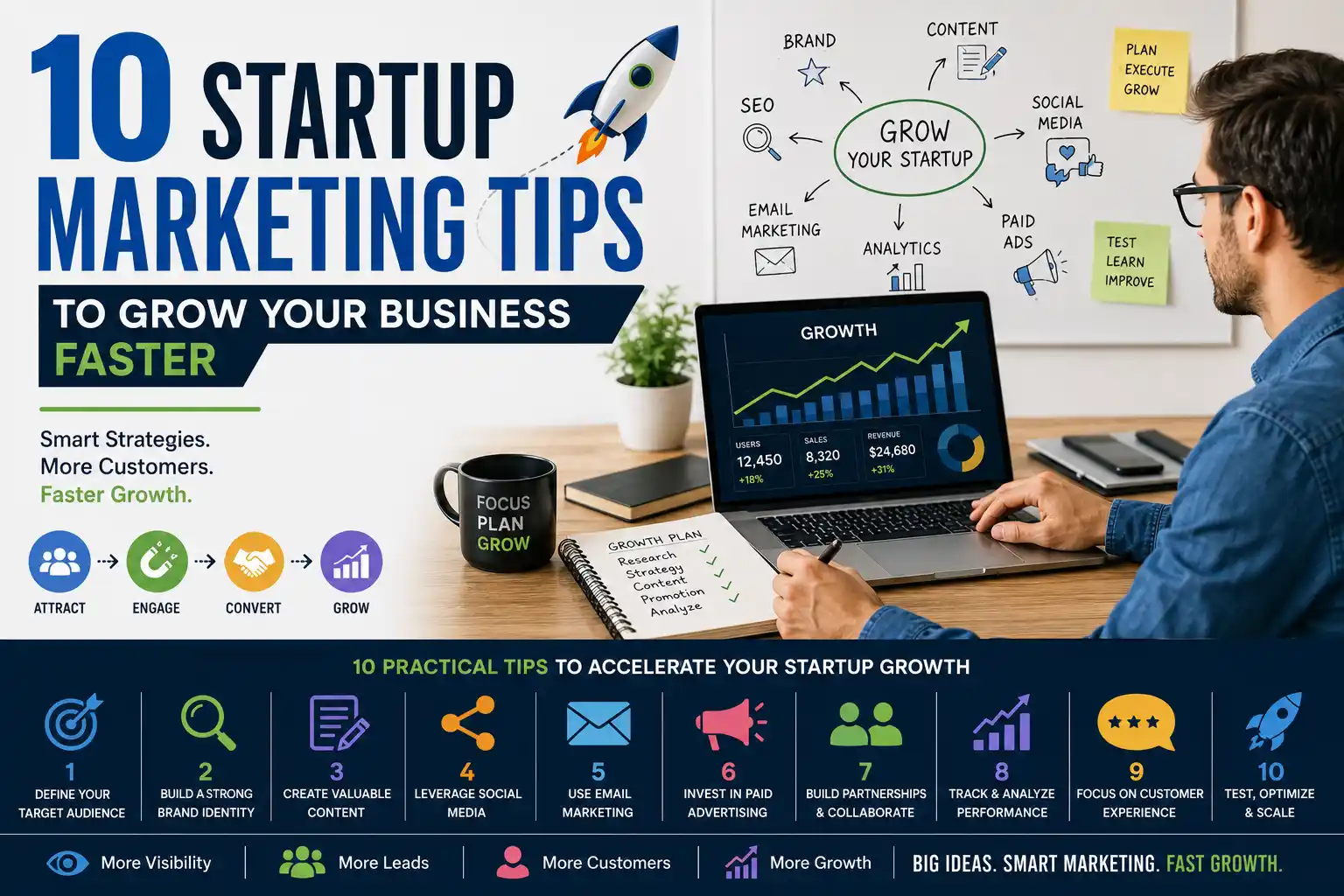
Most startups don’t fail because the product was bad. They fail because nobody found out it existed in time to matter.
That’s the gap effective startup marketing tips are meant to close. With a limited budget and pressure to show traction fast, founders can’t afford to guess their way through marketing — they need a focused approach that turns a great product into a growing customer base.
This guide walks through the fundamentals of startup marketing and ten practical tips you can put to work right away, whether you’re pre-launch or already chasing your next growth milestone.
What’s the Best Startup Marketing Strategy?
The best startup marketing strategy is to find one core channel that fits your product and audience, then double down on it once it proves it can grow profitably. Pair that channel with a clear brand story, consistent content, and a tight feedback loop so your product and your messaging keep improving together.
Why Does Marketing Matter So Much for Startups?
A great product alone rarely builds a big audience, and no amount of marketing saves a product nobody wants. Startups need both working in tandem.
Marketing shapes brand identity, drives customer acquisition, informs product development through direct feedback, and signals traction to investors — all reasons smart startup marketing tips matter so much for early-stage founders. Roughly a fifth of startups fail specifically because of marketing missteps, not because the product itself was flawed.
What Are the Core Foundations of Startup Marketing?
Before spending on ads or chasing every new platform, a few foundational steps make everything else more effective.
- Know your target audience deeply. Understand pain points, motivations, and behavior — not just age and job title. Niching down often beats trying to serve everyone.
- Set clear, measurable goals. SMART goals keep a small team focused instead of chasing every shiny metric.
- Define your brand identity. This goes beyond a logo — it’s your mission, voice, and the story that makes people remember you.
- Find your core marketing channel. Test broadly early, then concentrate budget on the channel with the best economics, growth potential, and defensibility.
- Build a customer feedback loop. Early-stage startups often learn more from feedback than from customers themselves — use it to refine both product and messaging.
What Are the Best Startup Marketing Tips to Apply First?
Once the foundation is in place, these ten startup marketing tips are where most founders see the fastest returns.
1. Build virality into your product
Some of the fastest-growing startups in history spent almost nothing on traditional marketing — instead, they engineered their product to encourage users to invite others.
Two things drive this kind of growth: time, and your product’s “viral coefficient,” or how many new users each existing user brings in. A coefficient above 1.0 can produce exponential rather than linear growth. A simple way to gauge this is asking users how likely they are to recommend your product to a friend.
2. Optimize your conversion rate before scaling spend
There’s little point sending more traffic to a page that isn’t converting. Conversion rate optimization starts with understanding why visitors leave, not with running random A/B tests.
Ways to uncover objections include:
- Live chat tools to talk with visitors in real time
- Short incentivized surveys
- User testing sessions
- Direct conversations with real customers
Once you know the objections, focus your changes on the highest-leverage areas first — usually your headline, your call to action, and your homepage experience.
3. Use paid social ads as a research tool
Paid platforms let you test dozens of narrow audience segments at once, making them one of the fastest ways to learn who actually converts — often surfacing segments you’d never have guessed organically.
4. Target early adopters before the mass market
Trying to appeal to the majority too early is a common and costly mistake. Most people resist unproven products; they wait for recommendations from innovators and early adopters first.
Focus your initial messaging and launch strategy on the smaller group willing to try something new. Once you’ve built case studies and testimonials from that group, the broader market becomes far easier to win over.
5. Lead with “why,” not just “what” or “how”
Products that explain why they exist tend to inspire stronger loyalty than those that only describe features. If your messaging leads with specs and functionality, you’re likely leaving persuasion on the table. Ask whether your homepage or pitch clearly communicates why your company exists before it explains what you sell.
6. Differentiate instead of blending in
People see thousands of ads a day, and near-identical messaging gets tuned out fast. Standing out isn’t about being first — it’s about consciously doing the opposite of what everyone else in your space is doing, from visual identity to tone of voice.
7. Invest in SEO and content early, even though it’s slow
Search engine optimization takes time to compound, but it captures customers at the exact moment they’re already looking for a solution — unlike ads, which interrupt what someone else was doing. Basic tactics like keyword-focused content, clean on-page structure, and mobile-friendly performance still form the backbone of most SEO strategies today.
8. Build a blog people actually want to read
Many startup blogs fail because they write about what the company wants to say rather than what the audience wants to read. A consistent publishing habit tends to compound into steady organic traffic and sign-ups over time.
9. Automate and personalize your email marketing
Generic newsletters have largely given way to behavior-triggered, segmented sequences — a nudge when a user signs up but doesn’t use a key feature, or a follow-up after an abandoned cart. Done well, email remains one of the highest-ROI channels available.
10. Track performance and be ready to pivot
Marketing for a startup is never “set and forget.” Set up dashboards for core metrics like customer acquisition cost, conversion rate, and engagement, then treat every campaign as a hypothesis to test rather than a fixed plan. The willingness to change direction based on real data is often what separates startups that scale from those that stall.
Which Paid Channels Are Worth Testing First?
Not every paid channel deserves a limited budget:
- Search ads — strong when people are actively searching for a solution like yours
- Social ads — useful for acquisition and audience research through granular targeting
- Remarketing — effective since you’re reaching people who already know your product
- Influencer and affiliate marketing — better as an accelerant once other channels are validated
Why Do These Startup Marketing Tips Matter for Growth?
Applying the right startup marketing tips affects far more than short-term sign-ups.
- Faster product-market fit: marketing channels double as feedback channels, surfacing what resonates and what doesn’t
- Lower cost per customer: a validated core channel scales more efficiently than scattering budget across untested ones
- Stronger investor confidence: demonstrated traction and a clear growth channel make fundraising conversations easier
- More resilient positioning: a differentiated brand is harder for competitors to displace with price alone
- Compounding organic growth: content and SEO investments made early keep paying off long after the initial effort
How Do You Choose the Right Channels for Your Startup?
Start by mapping where your ideal customers already spend time and how they typically discover products like yours. A B2B SaaS company evaluated by procurement teams will likely get more from LinkedIn and search than a purely visual platform, while a consumer app aimed at younger audiences may see the opposite.
Next, weigh your budget realistically. Some paid channels have minimum spend thresholds that put them out of reach for early-stage startups — prioritize channels with a lower cost of experimentation first.
Finally, resist running five channels at once. Testing broadly to find your core channel differs from permanently splitting attention across everything; once something works, concentrate resources there.
Common Mistakes to Avoid When Applying Startup Marketing Tips
- Chasing the mass market too early, before early adopters have validated the product
- Running A/B tests before understanding why visitors are leaving
- Spreading a small budget across too many channels instead of finding one that works
- Writing content for the company’s ego instead of the audience’s actual questions
- Ignoring performance data and sticking with a channel out of habit rather than results
Expert Tips for Smarter Startup Marketing
- Treat every campaign as an experiment with a hypothesis, not a guaranteed outcome.
- Meet the people who matter in your industry in person when you can — valuable partnerships often start simply by showing up at the right event.
- Repurpose content across formats — one well-researched article can become a video, an email sequence, and several social posts.
- Revisit your core channel periodically; what worked at launch may not scale the same way a year later.
Frequently Asked Questions
What is the most important marketing tip for a new startup?
Finding one core channel that fits your audience and doubling down on it matters more than spreading effort across many channels at once.
How much should a startup spend on marketing?
There’s no fixed rule, but spending should be tied to positive ROI — if a channel profitably acquires customers, it’s usually worth continued investment.
Is paid advertising necessary for startup growth?
Not always. Many startups grow primarily through content, SEO, and word-of-mouth, though paid channels can accelerate audience learning even on a modest budget.
How do startups get marketing exposure without a big budget?
Content marketing, SEO, genuine industry relationships, and product-led virality are among the most cost-effective ways to gain traction early on.
How can startups compete with larger, better-funded companies?
By being distinct rather than louder — sharper positioning and a stronger connection with a niche audience can outweigh a competitor’s bigger budget.
Conclusion
The best startup marketing tips are only useful when applied with focus rather than scattered across every channel at once. Start with a strong product and a clear brand story, find the one channel that performs best for your audience, and build a feedback loop that keeps improving both messaging and product.
Startups that treat marketing as an ongoing experiment — testing, measuring, and adjusting — consistently outperform those chasing every new tactic without a clear strategy behind it.