
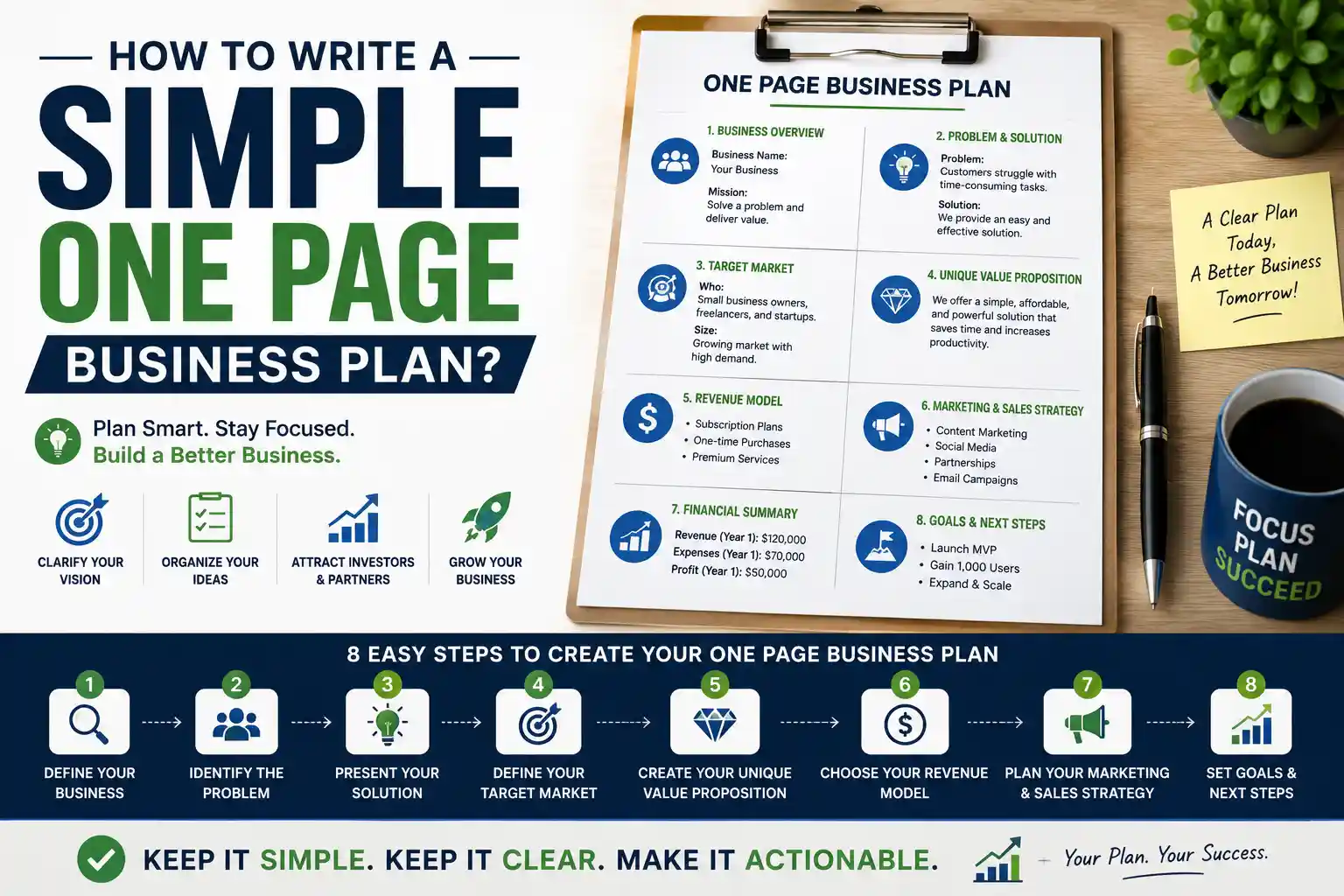
Most business plans never get read past the first few pages — not because the ideas are bad, but because a 40-page document is simply too much for busy founders, partners, or lenders to get through. That’s exactly the problem a one page business plan template is built to solve.
Instead of drowning your idea in projections and filler, a one-page plan forces you to distill your business down to what actually matters: what you’re building, who it’s for, and how it makes money. It’s fast to write, easy to update, and — unlike its longer cousin — it’s a document people actually use.
This guide walks through what belongs on a one-page business plan, a section-by-section breakdown you can fill in today, and a simple example to show what it looks like in practice.
What Is a One Page Business Plan?
A one-page business plan is a condensed version of a traditional business plan that captures your business idea, target customer, revenue model, and key goals on a single page. It typically includes a short business summary, the problem you solve, your target market, your revenue model, a rough financial snapshot, and a handful of near-term milestones — each written in just a few sentences.
Why Write a One-Page Business Plan Instead of a Full One?
A one-page business plan isn’t a shortcut for the sake of laziness — it’s a different tool for a different purpose. Traditional business plans are useful for formal loan applications or detailed investor due diligence, but for day-to-day clarity, they’re often overkill.
A one-page plan works well because it:
- Forces clarity by giving you limited space to say what actually matters
- Takes 30–60 minutes to draft, rather than weeks
- Is easy to revisit and update as your business evolves
- Doubles as a fast way to explain your business to partners, banks, or early hires
- Works as a useful idea-validation exercise, since vague ideas are hard to compress into a page
Think of it less like a formal document and more like your business’s elevator pitch, written down.
What Sections Should a One-Page Business Plan Include?
While formats vary slightly, most effective one-page business plans cover the same core sections. Keep each one to two or three sentences.
- Business summary — A short overview of what your business does and who it serves, written in plain language.
- The problem — What pain point or unmet need does your business address? Be specific.
- The solution — How does your product or service actually solve that problem?
- Target market — Who is your ideal customer, and how big is that market?
- Revenue model — How will the business make money? Subscriptions, one-time sales, services, etc.
- Marketing plan — How will customers actually find and choose you?
- Competitive landscape — Who else solves this problem, and what makes you different?
- Financial snapshot — Rough pricing, expected costs, and a break-even estimate, even if it’s a labeled estimate rather than a precise figure.
- Team — Who’s involved, and what makes them the right people to build this?
- Milestones — Four to six concrete, time-bound goals for the next six to twelve months.
Not every business needs every section — trim or combine as needed, but keep the total to one page.
How Do You Write a One-Page Business Plan Step by Step?
Here’s a practical process for going from a blank page to a finished plan in under an hour.
1. Set a timer and fill in the easy parts first
Start with business name, offer, customer, location, pricing, and next steps. Don’t pause to research every blank — if something is unclear, leave a quick note and keep moving. The goal of the first draft is getting the business out of your head and onto the page, not writing something polished.
2. Tighten your business summary, problem, and solution first
These three sections need to be clear before anything else, since everything else builds on them. Write them in plain language that a customer, banker, or partner could understand without industry jargon.
3. Add whatever numbers you have
Use your pricing, expected sales volume, major costs, revenue target, or break-even point if you know them. If you don’t have exact figures yet, use a realistic estimate and label it clearly as an estimate rather than presenting it as fact.
4. Write two to three sentences per section
For each core bullet point, expand it into two or three sentences that summarize the key details. Resist the urge to over-explain — the format only works if you stay disciplined about length.
5. Add a small number of concrete milestones
List four to six SMART (Specific, Measurable, Achievable, Relevant, Time-bound) milestones for the next six to twelve months. These turn your strategy into something actionable rather than aspirational.
6. Review, tighten, and revisit regularly
Once your draft is done, read it back and cut anything that isn’t essential. Treat this as a living document — review it quarterly, or whenever something major changes in your strategy, pricing, or market.
What Does a Filled-In Example Look Like?
Here’s a simplified example for a fictional meal-prep startup:
- Business summary: GreenBite Meal Prep delivers ready-to-eat, health-focused meals to busy professionals across the region.
- Problem: Health-conscious professionals struggle to eat well consistently due to limited time for cooking.
- Solution: Weekly subscription meal delivery with chef-prepared, nutritionist-approved meals ready in minutes.
- Target market: Working professionals aged 25–45 in urban areas with disposable income and limited cooking time.
- Revenue model: Weekly subscription plans, with optional à la carte add-ons.
- Marketing plan: Social media content, local gym partnerships, and referral incentives.
- Financial snapshot: Average order value of $65/week; break-even projected at 500 active subscribers.
- Milestones: Reach 100 subscribers in 3 months; expand to a second city within a year.
Notice how tight each section is — that constraint is the entire point of the format.
Why Does a One-Page Business Plan Matter for Founders?
A one-page business plan isn’t just a nice-to-have — it delivers real, practical value at every stage of a business.
- Speeds up decision-making: with your strategy condensed, it’s easier to check new ideas against your core plan.
- Improves communication: it’s far easier to share and explain a one-pager with partners, employees, or lenders than a lengthy document.
- Keeps you focused: revisiting a short plan regularly helps prevent scope creep and distraction.
- Supports fundraising conversations: while investors may eventually want more detail, a sharp one-pager is often the first thing that gets you a follow-up meeting.
- Adapts easily: because it’s short, updating it as your business changes takes minutes, not hours.
Common Mistakes to Avoid
- Trying to fit a full business plan onto one page by shrinking the font instead of actually cutting content.
- Skipping the financial snapshot entirely, even a rough, clearly labeled estimate is more useful than leaving it blank.
- Writing vague milestones like “grow the business” instead of specific, time-bound goals.
- Treating it as a one-time document instead of revisiting and updating it as your business evolves.
- Overloading it with jargon that a customer, banker, or new hire wouldn’t immediately understand.
Expert Tips for a Stronger One-Page Business Plan
- Write your business summary last, even though it appears first — it’s often easier to summarize the whole plan once every other section is drafted.
- Use a template as a starting structure, not a rulebook; adjust sections to fit your specific business model.
- If a section feels hard to write in two or three sentences, that’s often a sign your thinking on that part of the business isn’t fully clear yet.
- Keep a running list of questions or unknowns your plan surfaces — these make excellent items to validate with real customers.
Frequently Asked Questions
Is a one-page business plan enough for a startup? For early-stage clarity and internal use, yes. If you’re seeking significant investment or a bank loan, you’ll likely still need a more detailed plan eventually, but a one-pager is a strong starting point.
How long should it take to write a one-page business plan? Most founders can produce a solid first draft in 30 to 60 minutes, especially if they already have a reasonably clear sense of their business.
What’s the difference between a one-page business plan and an executive summary? They’re very similar — a one-page plan is essentially a structured, slightly more detailed version of a strong executive summary, following the same core sections as a traditional plan.
Should I use a template or write it from scratch? Either works. A template gives you structure if you already have a clear picture of your business; writing freely can help if you’re still figuring out how to frame your idea.
How often should I update my one-page business plan? Review it quarterly, or any time something significant changes — new pricing, a shift in target market, or a major strategic pivot.
Conclusion
A one page business plan template isn’t about cutting corners — it’s about forcing the kind of clarity that a sprawling document often obscures. By distilling your business down to its essentials, you get a plan you’ll actually use, update, and share.
Set aside an hour, work through each section, and you’ll walk away with a clear, working plan instead of a document that sits untouched on a hard drive.