
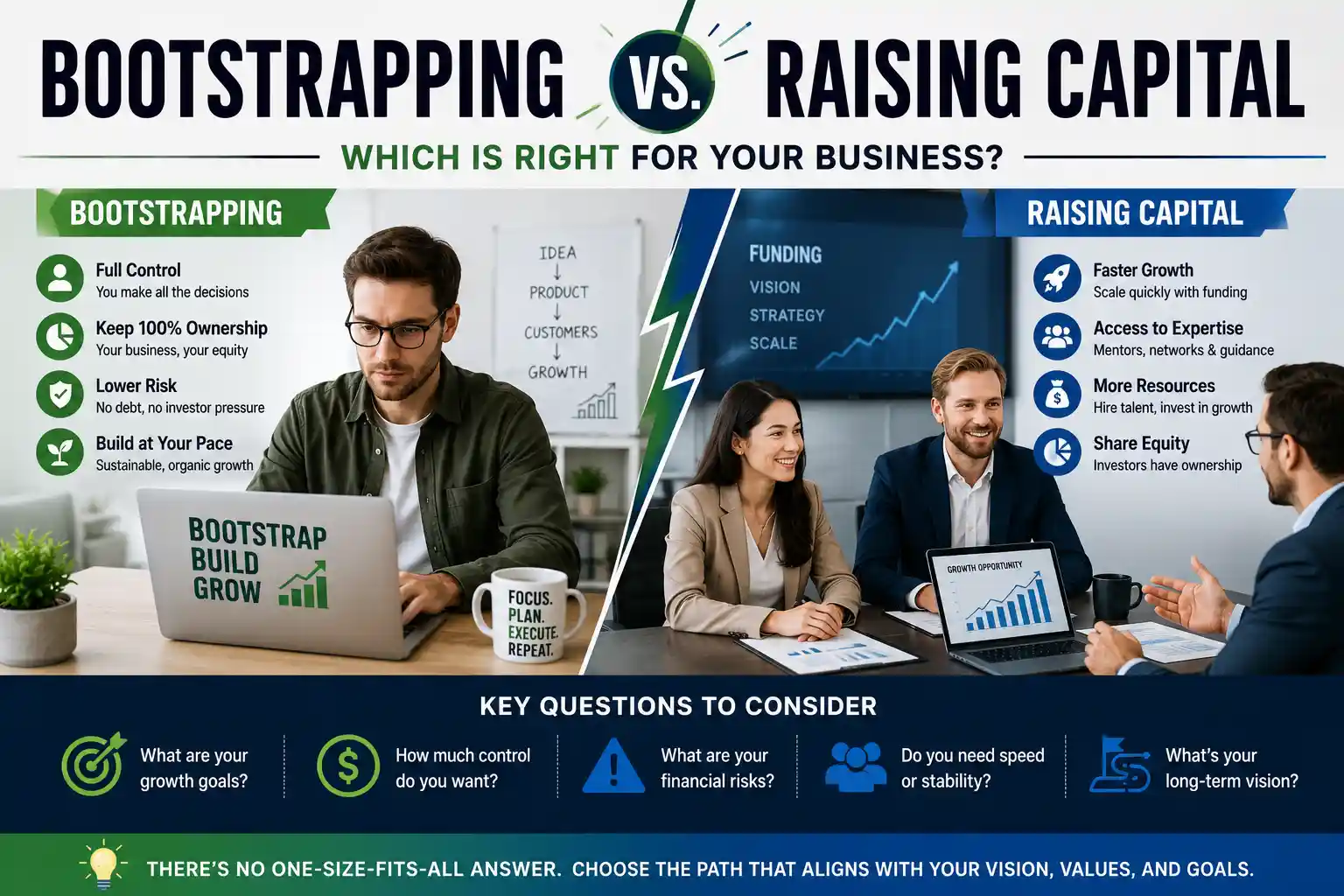
Every founder eventually faces the same fork in the road: fund the business yourself, or bring in outside investors. Get it wrong, and you either run out of cash too soon or give away more control than you needed to.
The bootstrapping vs. raising capital decision isn’t about which path is objectively better — it’s about which one fits your business model, growth ambitions, and appetite for risk. Roughly 77% of founders cite personal savings as their primary funding source, and only a tiny fraction of startups ever raise venture capital at all. Bootstrapping isn’t the fallback option; for most businesses, it’s the default.
This guide breaks down what each path actually involves, the trade-offs founders consistently report, and how to decide which one — or which combination — makes sense for your business.
Should You Bootstrap or Raise Capital?
Bootstrap if you want to retain full ownership and control, have a business model that can generate early revenue, and are comfortable growing more slowly. Raise capital if your market requires rapid scaling to compete, your business needs significant upfront investment before it can generate revenue, or investor expertise and networks would meaningfully accelerate your growth. Many founders also blend the two — bootstrapping early to prove traction, then raising on stronger terms later.
What Is Bootstrapping?
Bootstrapping means building your company using personal savings, early customer revenue, and whatever resources you can stretch — without raising outside equity funding. You fund growth using cash the business itself generates, rather than money from investors.
This approach forces discipline. Every dollar spent has to be justified by what it returns, which often pushes founders toward frugality and faster paths to profitability than they might otherwise pursue.
What Is Venture Capital, and How Does It Differ?
Venture capital (VC) means selling equity to professional investors in exchange for capital you can deploy immediately, often well ahead of profitability. VC-backed startups typically pursue rapid, ambitious growth, since investors are betting on a small number of large wins rather than steady, modest returns.
This distinction matters: venture investors aren’t usually looking for a stable, profitable small business — they’re looking for the kind of exponential growth that can return their fund many times over. A solid, profitable business idea can still get turned down by VCs simply because the opportunity isn’t large enough for their return requirements.
What Are the Pros and Cons of Bootstrapping?
Bootstrapping comes with real advantages, but also real constraints founders should weigh honestly.
Advantages:
- Full ownership retained — no equity given up, no cap table to manage
- Complete control — no board meetings, no investor approval needed for decisions
- Customer-driven focus — you build for real paying demand, not for what impresses investors
- Financial discipline — limited runway naturally pushes toward efficient, sustainable growth
- Stronger negotiating position later — founders who bootstrap first often raise on better terms, since they’re negotiating from traction instead of a pitch deck
Drawbacks:
- Limited runway — your own cash flow is your growth ceiling
- Slower growth — without outside capital, scaling takes longer
- Personal financial risk — your own savings and stability are on the line
- Missed access to networks — investors often bring expertise, connections, and credibility that are harder to replicate alone
- Competitive vulnerability — a well-funded competitor may be able to move and hire faster
What Are the Pros and Cons of Raising Venture Capital?
VC funding solves many of bootstrapping’s constraints, but introduces its own set of trade-offs.
Advantages:
- Access to significant capital — enough to hire, build, and scale faster than organic revenue alone could support
- Expert guidance and mentorship — many VC firms actively help portfolio companies with strategy and hiring
- Valuable networks — introductions to customers, partners, and future investors
- Credibility and validation — a known investor backing your company can open doors with customers and talent
- Room to prioritize growth over near-term profitability — useful for markets where speed determines the winner
Drawbacks:
- Equity dilution — you give up a percentage of ownership, and potentially future decision-making power
- Loss of full control — investors typically expect a board seat, reporting, and input on major decisions
- Growth pressure — VC funding comes with expectations for rapid, outsized growth, not steady profitability
- Eventual exit expectations — most VC-backed paths assume an eventual acquisition or IPO, which shapes long-term strategy
- Difficult to secure — the vast majority of startups that seek venture capital never get it, since the model depends on very specific growth potential
How Do You Decide Between Bootstrapping and Raising Capital?
There’s no universally correct answer — only trade-offs that fit some businesses better than others. A few questions can help clarify the right path for yours.
How capital-intensive is your business? A software product with low overhead may be entirely bootstrappable, while a business requiring manufacturing, inventory, or specialized infrastructure often needs outside capital just to get off the ground.
How competitive and time-sensitive is your market? If competitors are already raising capital and racing to capture the same customers, bootstrapping alone might be too slow to keep pace. If your market rewards patience and steady execution more than speed, bootstrapping can be a real strategic advantage.
How much control do you want to retain? Founders who value full decision-making authority and don’t want a board weighing in on strategy often lean toward bootstrapping for as long as possible.
What’s your personal risk tolerance? Bootstrapping puts your own financial stability on the line in a very direct way. Raising capital shifts some of that risk to investors — but adds pressure and oversight in return.
What Funding Options Exist Beyond Bootstrapping and VC?
Bootstrapping and venture capital aren’t the only two options. Several hybrid and alternative paths can bridge the gap between them.
- SAFE notes — a simplified agreement that converts to equity later, often used for smaller early raises without a full valuation negotiation.
- Revenue-based financing — investors provide upfront capital in exchange for a percentage of future revenue until a fixed return is reached, without taking equity.
- Venture debt — a loan (sometimes paired with warrants) that provides capital without directly diluting ownership, typically available once a company has some traction.
- Angel investors — individual investors who often provide smaller amounts of capital earlier than institutional VCs, sometimes with valuable hands-on guidance.
- Crowdfunding — raising smaller amounts from a large group of backers, often in exchange for early product access rather than equity; useful for validating demand as well as raising funds.
- SBA and microloans — government-backed loans that reduce lender risk, making them more accessible to early-stage businesses without a long credit history.
- Equipment or asset-based financing — loans secured against specific business assets, useful for capital-intensive purchases without giving up equity.
Why Does This Decision Matter for Long-Term Success?
The path you choose shapes far more than your bank balance — it influences your company’s culture, pace, and eventual exit options.
- Ownership and equity: bootstrapping preserves your cap table; VC funding reshapes it with every round.
- Growth trajectory: capital-backed companies can often out-hire and out-market bootstrapped competitors, but at the cost of built-in pressure to keep growing.
- Decision-making speed: founders without a board can move faster on smaller decisions, while VC-backed founders gain resources but add layers of approval.
- Exit expectations: VC funding generally assumes an eventual sale or IPO, while bootstrapped businesses can choose to stay independent indefinitely if they want.
- Resilience under pressure: bootstrapped businesses built around real revenue are often better positioned to survive downturns than capital-dependent ones burning through runway.
Common Mistakes to Avoid
- Raising capital before proving product-market fit, which can lead to giving up more equity than necessary for validation you could’ve gotten more cheaply.
- Bootstrapping a business that genuinely requires significant upfront capital, delaying the point where the product can compete effectively.
- Treating VC funding as “free money” rather than a financial obligation that comes with real expectations and growth pressure.
- Ignoring hybrid options like revenue-based financing or SAFE notes that don’t fit neatly into the bootstrap-or-VC binary.
- Choosing a funding path based on prestige rather than what actually fits the business model and market.
Expert Tips
- Model out dilution scenarios before your first raise — understanding what a 20% stake costs you at different valuations makes negotiations far less intimidating.
- If you do bootstrap first, keep detailed records of your traction and unit economics; strong data makes future fundraising conversations move faster.
- Talk to founders who’ve taken each path in your specific industry — the trade-offs can look very different in capital-intensive sectors versus low-overhead software businesses.
- Remember that funding choice isn’t necessarily permanent — many successful companies blend bootstrapping and outside capital at different stages.
Frequently Asked Questions
Is bootstrapping better than raising venture capital? Neither is universally better — bootstrapping preserves ownership and discipline, while venture capital buys speed and resources at the cost of equity and control. The right choice depends on your market, goals, and risk tolerance.
Can you bootstrap first and raise capital later? Yes, and many founders do exactly that. Proving traction through bootstrapping often leads to a stronger negotiating position, better valuation, and less dilution when you eventually raise.
How much of my company do I give up when raising VC funding? It varies widely by stage and deal terms, but early rounds commonly involve giving up somewhere between 10% and 25% of equity, with further dilution in each subsequent round.
What percentage of startups actually raise venture capital? Very few — some estimates put it at roughly 0.05% of startups, making bootstrapping and other funding sources the far more common path.
Is revenue-based financing a good alternative to venture capital? It can be, especially for businesses with predictable recurring revenue. It avoids equity dilution but takes a percentage of future revenue until a fixed return is met, which reduces cash flow available for other investments.
Conclusion
The bootstrapping vs. raising capital decision ultimately comes down to what kind of founder you want to be and what your business genuinely needs to succeed. Bootstrapping rewards discipline, ownership, and patience; venture capital trades equity and control for speed and resources.
There’s no single right answer — only the path, or combination of paths, that best matches your market, your risk tolerance, and the business you’re trying to build.