
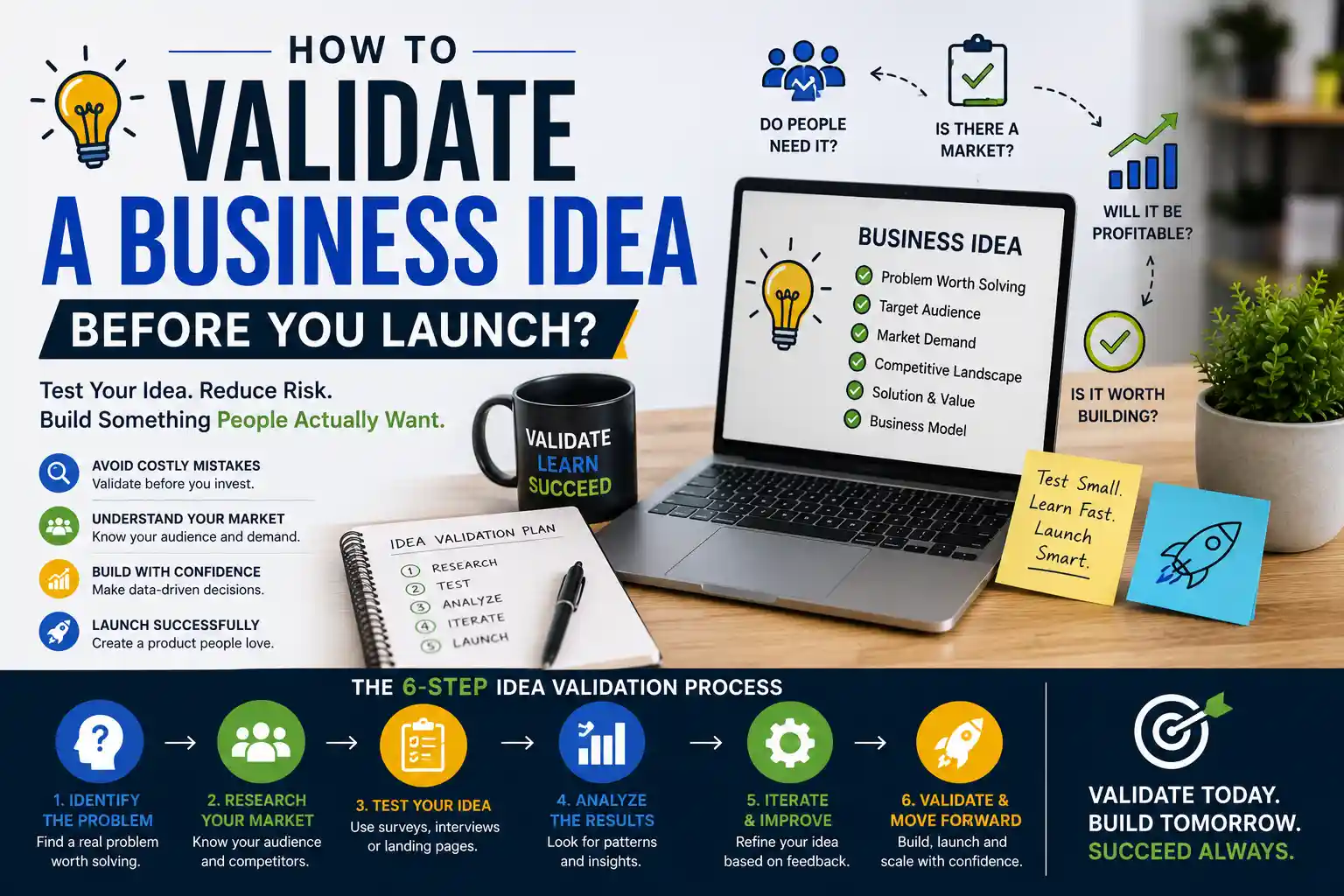
Plenty of founders skip straight from “I have an idea” to building the product, only to discover months later that nobody was actually willing to pay for it. By then, the money, time, and motivation are already gone.
Business idea validation is the process that prevents this. It’s how you test whether a real, painful problem exists, whether people will pay to solve it, and whether your idea is worth building before you commit serious time and money to it.
This guide walks through what validation actually means, the warning signs that your idea isn’t validated yet, and a practical step-by-step process you can use to test your idea with real evidence instead of guesswork.
How Do You Validate a Business Idea?
To validate a business idea, define your target market and their specific problem, form a testable hypothesis about that problem, talk directly to potential customers to see if the problem is real and painful enough that they’re already trying to solve it, and then build a minimum viable product (MVP) to test whether your solution actually gets used and paid for.
What Is Business Idea Validation, and Why Does It Matter?
Business idea validation is the process of testing your assumptions about a business — who the customer is, what problem they have, and whether your solution is something they’ll actually pay for — before you invest heavily in building it.
It’s easy to confuse enthusiasm for validation. Friends saying they “love the idea,” a handful of sign-ups from people you know, or excitement about all the industries you could sell to someday can all feel like progress. None of that is proof.
Real validation separates a problem worth solving from a nice idea nobody actually needs. Skipping it is one of the most common — and most expensive — mistakes founders make.
What Are the Warning Signs Your Idea Isn’t Validated Yet?
Before diving into the process, it helps to recognize when you’re still working with assumptions rather than evidence:
- People say they love your idea, but nobody has actually paid for it
- Potential customers regularly misunderstand what you do, or describe it in vague terms
- Most of your limited budget is going toward new features instead of customer conversations
- You have a few customers but can’t explain why they bought or what’s working
- You describe your target market as “everyone,” and investors visibly react to that
If several of these sound familiar, more validation work is needed before you scale anything.
How Do You Validate a Business Idea Step by Step?
Here’s a practical framework for testing a business idea before committing significant time or money to it.
1. Separate the problem from the product
Validating a problem and validating a product are two different things, and both matter. You need evidence that a problem is painful enough that people are actively trying to solve it, and later, evidence that your specific product actually helps them do that in a way that can support a sustainable business.
2. Define your market and your customer
Start by answering a few core questions:
- Who is your market? The broad group of people who operate in your product’s space.
- What is your beachhead? The specific slice of that market most likely to understand your value immediately.
- Who is your actual customer? Not just who benefits, but who is likely to buy.
- What are they using today? Every real problem already has some kind of workaround, however imperfect.
- Who has high urgency and low ability to solve it themselves? This combination often points to your best early customers.
3. Research the market and search demand
Beyond talking to people, understand broader market signals: how large and active the space is, whether search interest around the problem is growing, and who else is trying to solve it. Keyword and market research tools can reveal whether people are actively searching for solutions like yours — a useful early signal of real demand.
4. Write a clear problem hypothesis
A problem hypothesis is a concise statement of what you believe to be true, which you can then test with real people. One useful format:
“We believe that if we create [a product around X], and if we do [short-term benefit], then [long-term benefit] will happen.”
Writing the hypothesis down forces clarity and gives you something specific to validate or disprove, rather than vaguely “testing an idea.”
5. Talk to real potential customers
This is the step founders most often skip or shortcut. Go beyond friends and family — you need honest input from people who genuinely represent your future customers. Useful methods include:
- One-on-one interviews focused on their current behavior and pain points, not your solution
- Short surveys, ideally with some incentive to encourage honest, detailed responses
- Watching people attempt to solve the problem today, rather than only asking them to describe it
- Direct conversations with a handful of prospective customers over a call or coffee
6. Study your competition
Understanding your competitors shows what’s already been tried and where the gaps are. Research this two ways:
- As a customer: sign up for competitor products, use them, and contact support to understand strengths and weaknesses firsthand.
- Through desk research: read reviews, press coverage, and public data on revenue or growth to understand how they operate and where they may fall short.
7. Confirm your hypothesis with evidence
After interviews and research, look for patterns rather than one-off opinions. A validated problem hypothesis typically shows that potential customers:
- Confirm the problem exists and believe it’s worth solving
- Have already invested real time, money, or effort trying to solve it
- Don’t have circumstances that block them from acting on a solution
- Consistently describe the problem in similar terms, even when interviewed separately
8. Build a minimum viable product (MVP)
Once you have evidence the problem is real, build the simplest possible version of your product that tests your core value proposition — not a polished, fully featured version. An MVP should:
- Capture the essential elements of your offer without extra complexity
- Be cheap and fast enough to build that a failed test doesn’t sink the business
- Give you something tangible to put in front of real users for feedback
- Operate within a fixed budget you commit to in advance, rather than scope-creeping indefinitely
9. Test, gather feedback, and iterate
Put the MVP in front of the people you interviewed and watch how they actually use it. Ask what worked, what confused them, and what they’d change. Use this feedback to refine the product — and expect your original hypothesis to shift as you learn more. That’s normal, not a sign of failure.
What Frameworks Can Help Structure Business Idea Validation?
A few widely used tools bring more structure to the process:
- Value Proposition Canvas — maps customer needs against what your product offers, sharpening your positioning.
- Business Model Canvas (BMC) — breaks a business into nine core components, including customer segments, channels, and revenue streams.
- Business Model Navigator (BMN) — a library of proven business model patterns that can inspire your own approach.
- Lean Startup methodology — centers on the build-measure-learn loop, treating your MVP as an ongoing experiment.
Why Does Business Idea Validation Matter for Long-Term Success?
Skipping business idea validation doesn’t just risk building the wrong product — it has ripple effects across the entire business.
- Saves time and money: it’s far cheaper to abandon or pivot a hypothesis than a fully built product.
- Improves investor confidence: an evidence-backed customer segment beats “we sell to everyone.”
- Sharpens your marketing: understanding the real problem and language customers use makes messaging clearer.
- Reduces wasted acquisition spend: targeting a validated segment means fewer resources chasing the wrong audience.
- Builds team confidence: clear evidence of demand keeps teams motivated and aligned, rather than guessing at direction.
Common Mistakes to Avoid in Business Idea Validation
- Validating only with friends and family, whose feedback is rarely objective.
- Asking if people would use your product, instead of observing what they already do to solve it today.
- Treating “everyone” as your market, which prevents any meaningful validation.
- Building a full product before testing the problem, wasting resources on unwanted features.
- Ignoring evidence that contradicts your idea because you’re emotionally attached to it.
Expert Tips for Stronger Business Idea Validation
- Not all problems are equal — a “nice to have” isn’t automatically a bad idea, but it needs a different marketing approach than a genuine must-have.
- Expect your problem hypothesis to evolve; treat early drafts as a starting point, not a fixed conclusion.
- Prioritize customers with high urgency and low ability to solve the problem themselves — they convert fastest and give the most useful feedback.
- Keep your MVP budget fixed in advance so validation stays focused on learning, not perfecting.
Frequently Asked Questions
What is the fastest way to validate a business idea?
Direct conversations with potential customers, paired with a simple MVP, are typically the fastest path to real evidence — much faster than building a full product first.
How many people should you talk to before considering an idea validated?
There’s no fixed number, but most founders start seeing consistent patterns after roughly 10–20 in-depth conversations with people who genuinely represent their target customer.
Is an MVP necessary for every business idea?
In most cases, yes. Even a simple MVP — a landing page, a manual service, or a basic prototype — gives you behavioral evidence that surveys and opinions alone cannot.
What’s the difference between validating a problem and validating a product?
Problem validation confirms people genuinely experience and want to solve a specific pain point. Product validation confirms your solution solves it well enough that people will pay for it.
Can a business idea be too niche to validate?
Rarely. A narrow, well-defined beachhead market is usually easier to validate — and market from — than a broad, vague one, even if it feels smaller at first.
Conclusion
Business idea validation isn’t a box to check before the “real” work begins — it is the real work. Defining your market, forming a clear hypothesis, talking to real customers, and testing with an MVP all reduce the risk of building something nobody wants.
Founders who commit to genuine business idea validation before scaling save time, money, and motivation — and walk into every future decision with real evidence instead of assumptions.